> In 2023, the Texas Legislature unanimously passed a law raising auto insurance costs for Texans by $1 to combat rampant catalytic converter theft.
> The Motor Vehicle Crime Prevention Authority, led by a board mostly appointed by Gov. Greg Abbott, has turned the $1 fee hike into at least 3,200 Flock cameras.
More coming. Meanwhile, secure your EV!!! Batteries will be next!!!
> Texas law allows you to use deadly force to protect property if you would be justified in using force, and you reasonably believe it is immediately necessary to prevent the imminent commission of specific enumerated property crimes. These are arson, burglary, robbery, aggravated robbery, theft during the nighttime, or criminal mischief during the nighttime.
> Sec. 9.42. DEADLY FORCE TO PROTECT PROPERTY. A person is justified in using deadly force against another to protect land or tangible, movable property:
> (1) if he would be justified in using force against the other under Section 9.41; and
> (2) when and to the degree he reasonably believes the deadly force is immediately necessary:
> (A) to prevent the other's imminent commission of arson, burglary, robbery, aggravated robbery, theft during the nighttime, or criminal mischief during the nighttime; or (B) to prevent the other who is fleeing immediately after committing burglary, robbery, aggravated robbery, or theft during the nighttime from escaping with the property; and
> (3) he reasonably believes that:
> (A) the land or property cannot be protected or recovered by any other means; or (B) the use of force other than deadly force to protect or recover the land or property would expose the actor or another to a substantial risk of death or serious bodily injury.
First off- Texas has an explicit law making copper and catalytic converter theft a "Jail felony"- but if you break any other laws on the way, it's upgraded to a class 3 felony. See: https://statutes.capitol.texas.gov/?tab=1&code=PE&chapter=PE... And. if you really want to play cops and robbers, a personally witnessed jail felony seems to be enough for a citzen's arrest.
Second: "(B) the use of force other than deadly force to protect or recover the land or property would expose the actor or another to a substantial risk of death or serious bodily injury." - YOU HAVE TO BE AFRAID FOR YOUR LIFE Texas gives citizens enourmous latitude in these matters, but it's not carte blanche for murder.
The Uvalde police department exhibited both cowardice and incompetence, but can we stop pretending they are representative of cops everywhere?
Just a year later during the mall shooting in Allen Texas, cops took down the white supremacist, neo-nazi perpetrator in under 5 minutes, probably saving at least a co couple dozen lives (he’d already killed 9). You can watch the bodycam footage from that event if there’s any doubt
Deadly force can be lawful in Germany as well, reading Texas law I wonder which nuances of the laws make the biggest difference (assuming there's one).
Could also be that the difference comes from owning land works differently in Germany (because it's much more densely populated) and of course owning anything except small guns is completely forbidden.
people freqently conflate Stand Your Ground vs Duty to Retreat... with the entire rest of the debate.
I'm trying to keep this neutral, so I'm using a rather cut and dry example: Somebody kicks in your door with a pump action and starts shooting- There are _some_ jurisdictions that require you to try and flee. You kill them and they werent bodily blocking your car in? Murder charge. investigation finds a sabatoged engine? Doesn't matter.
Stand Your Ground assumes reasonableness and codifies leaveing the fight or flee decision up to the individual.
Your example isn't quite as cut-and-dry because in a lot of cases that's going to involve the Castle Doctrine as well, and "starts shooting" means there is an actual danger merely than a perceived potential danger.
Counter-example: You're walking on the streets, at night, in the "bad part" of town. Someone walks towards you with their hands in their pockets, and their head covered with a hoodie. They say "Hey, what are you doing here?". You perceive this to be a threatening situation and fear for your life. Are you supposed to: a) pull out your gun and shoot them, or b) run away?
Some proponents of Stand Your Ground would say that option A is perfectly fine, some proponents of Duty To Retreat would say that you must attempt option B first, and fall back to option A only as a last resort.
It seems I may have misremembered my example and inadvertantly made duty to retreat appear worse than it is. However- it was meant to highlight the positons both sides and it holds correct enough for thst still.
> Somebody kicks in your door with a pump action and starts shooting- There are _some_ jurisdictions that require you to try and flee. You kill them and they werent bodily blocking your car in? Murder charge.
Which jurisdictions? Is this in the US? I’ve lived in a bunch of European countries and in none would you be charged with murder in that situation.
Germany has had some weird court decisions in that regard, in general the law does say flee and not shoot back if this is an option. But mostly courts are reasonable and do not punish the victim. Only if the victim decides to use violence after the threat is over
But there was even a case, where a hells angel shot a police officer in his home who were doing a raid - and got free (because they did not identify themself as police).
The law says your are allowed to stand your ground. You don't have to flee.
> But there was even a case,
I don't know the details of the case, but if somebody thought some criminals are raiding his house with guns and it's reasonable the he thought that, then he's fully within his rights to defend himself and, depending on the necessities, by shooting at them.
> Allerdings gilt besonders hier der Grundsatz, dass das Unrecht dem Recht nicht zu weichen braucht. Man darf sich zur Wehr setzten und muss nicht flüchten.
Translation:
> However, the principle that wrongdoing need not give way to what is right applies here in particular. One is allowed to defend oneself and is not required to flee.
I believe that's pretty common and a sane approach.
"In bestimmten Situationen kann das sonst umfassend geltende Notwehrrecht eingeschränkt sein. Dies ist dann der Fall, wenn die Verteidigung außer Verhältnis zum Angriff steht."
"Besonderes gilt bei dem Einsatz von Schusswaffen."
"Auch wird das Notwehrrecht eingeschränkt, wenn der Angriff von schuldlos Handelnden wie Kindern, Betrunkenen oder Geisteskranken ausgeht. Hier muss zunächst versucht werden, dem Angriff auszuweichen. Erst wenn ein Ausweichen nicht möglich ist, ist eine Notwehrhandlung geboten"
In other words, my statement above was in those words indeed not exact correct - you don't must flee before shooting, but germany does not has a "home is your castle" law.
Sure, there are sane guardrails in place. Your are not allowed to shoot at somebody who steals a bottle of water from you or makes a picture of you against your will. You also correctly mentioned kids or sick people that do not have a criminal intend in a narrow sense.
Generally however, you don't have to flee and the defence doesn't need to be proportionate to the attack or what you are defending.
You just generally have to choose the mildest defence available to you that you can reasonably know having under an ongoing or imminent attack - you don't have to "take your time and look around" if some milder defence is around the corner.
"Anthony Edward Martin was an English farmer who shot two burglars in his home [...] was convicted of murder, which was later reduced to manslaughter on grounds of diminished responsibility"
> The prosecution accused him of lying in wait for the burglars and opening fire without warning from close range, in retribution for previous break-ins at his home.[13]
No warning shot.
He also llegally bought a semi-automatic pump shotgun, possibly with the explicit plan to kill the intruders (as he got robbed in the past).
He also shot at them while they were fleeing.
So, yeah, in this particular case the judge decided that what he did was not covered by the law.
If someone comes through your home door guns akimbo in the US, blasting back is fine
US Supreme court has often leaned heavily on right to protect self in one's own home in ruling against local and state laws that might ban ridiculous things.
Examples? Maybe it’s true but I’d be surprised. Like I said from experience of living under a number of jurisdictions, none will charge a person with murder in those circumstances. Everywhere I’ve lived, if your life is directly threatened like that, you are absolutely allowed to defend yourself with violence commensurate with the threat.
They may have been confusing or deliberately conflating things with the fact that in most western jurisdictions, you are not allowed to kill, for example, a fleeing trespasser or burglar. This is viewed as an entirely different situation from one where you are being threatened directly with immediate physical violence.
Only when threatened and self-defense has to be proportionate. If someone attacks you with a knife you would not be allowed to defend yourself with a firearm if you had one.
This is very different from the law in Texas, where, from what I understand, if you catch someone in the night stealing you could just kill them even if they never threatend you.
> Only when threatened and self-defense has to be proportionate. If someone attacks you with a knife you would not be allowed to defend yourself with a firearm if you had one.
Being attacked with a knife means your life is being threatened and using a firearm would be legal even in Germany. The response has to be proportionate to the threat on life or limb not the size of the weapon.
Your are not arguing against the parent comment, right?
Because when somebody attacks you with a knife, drawing a gun oftentimes will not even be an effective defense. But if that is all that's available to you, it's only reasonable to give it a try. You should shoot multiple times or empty the whole magazine though and yes, that's generally justified by the law if that's what it takes to stop the attack.
The exact thing has happened to police man and woman and yes, they get trained to shoot multiple times to defend themselves. Was an outcry in media a few times because people don't understand the situation those people were put into.
I'm saying that when you use a gun against an attacker with a knife you will end up before a judge as the defendant and not as the victim. The court will decide if using the gun in this specific case was necessary (notwendig) and appropriate (geboten). Only if it was both will you go unpunished.
> The response has to be proportionate to the threat
No, not even that, at least not in general. For example, it could be well within your rights to hit somebody who keeps insulting you.
And yes, not getting insulted is a protected right in Germany that you generally lawfully defendable under the "Notwehr" laws.
Wikipedia mentions more example of what you are generally allowed to protect:
> Das unberechtigte Anfertigen einer Fotoaufnahme stellt einen Angriff auf das Recht am eigenen Bild dar.[10] Das Anrauchen einer Person kann einen Angriff auf deren Ehre und Gesundheit darstellen.
Translation:
> Taking a photograph without authorization constitutes an infringement of the right to one's own image.[10] Exposed to secondhand smoke can constitute an infringement of a person's honor and health.
Will be easy enough to find more example if your are not satisfied with Wikipedia.
Yes, find an example that proofs that "not getting insulted is a protected right in Germany that you generally lawfully defendable under the "Notwehr" laws.", as you claim.
Neither of your sources supports "you may hit someone who keeps insulting you.". If you had linked the original sources, it would have been obvious that the examples are taken out of context.
> Bereits der Diebstahl mittelwertiger Gegenstände darf nach herrschender Meinung jedoch auch mit einer tödlichen Abwehrhandlung vereitelt werden, sollten mildere Mittel (wie Warnschüsse oder Schüsse auf die Beine) nicht zum Erfolg geführt haben bzw. nicht zur Verfügung stehen.[73][55][56]
> However, according to prevailing opinion, even the theft of items of moderate value may be thwarted by lethal self-defense if less severe measures (such as warning shots or shots aimed at the legs) have failed or are not available.[73][55][56]
He was also hit by the six year olds, but the court explicitly mentions the attack on his honor as well as foundation for their judgement.
Slapping the child was deemed to be the mildest mean for defence and therefore lawful.
Just to iterate on the first point, even theft of values starting as low as 100 Euro could justify lethal force. Knowing that honor is a protected right, it should not be surprising that hitting somebody can be justified when one get heavily and continuously insulted.
Your claims were that "not getting insulted is a protected right in Germany that you generally lawfully defendable under the "Notwehr" laws." and that "you may hit someone who keeps insulting you.".
Search for Texas castle doctrine. The intention is to provide extreme deterrence against home invasion crimes. The liability for shooting a person, for any reason, in Texas outside the home is much greater.
> in Texas, where, from what I understand, if you catch someone in the night stealing you could just kill them even if they never threatend you.
It's worth pointing out that night is doing some of the work in this statement. Texas is unusual, as far as I know, that darkness makes a big difference in how self-defense and danger are viewed. It kinda makes sense, because in the dark, the would-be victim is less able to fully and accurately assess the situation. So Texans need to be aware that their actions may be interpreted more harshly in the dark.
> Only when threatened and self-defense has to be proportionate. If someone attacks you with a knife you would not be allowed to defend yourself with a firearm if you had one.
No, that's explicitly not the case, it doesn't has to be proportionate, only needs to be the mildest defence available to you that will stop the attack.
Not sure where people get the idea that the defense has to be proportionate, for some reason many believe that.
Defending yourself with a gun against an attacker with a knife is well within your rights (assuming that drawing and defending with a gun would even be effective).
About Germany, §32 StGB doesn't require proportionality, the test is "Erforderlichkeit" or "necessity". So if you only have a gun and get attacked by a knife, you don't have to "make things even".
Of course, if someone is simply stealing a Catalytic Converter you can't really shoot them, as it's a bit much... you can point a gun at them, and possibly even shoot the air, that's easier to argue as self-defence. If they threaten you back, the situation changes.
The problem is having a gun in the outside, in Germany, good luck with that... of course, if it's someone stealing something inside your house, it becomes a home invasion, which is a completely different thing than someone stealing your property on the street.
It's way more nuanced than Texas, which has a bit more clear cut law.
But if the "mildest mean available" of self-defence against a knife assailant is a gun, the a gun is the most appropriate, simply because others aren't available. Naturally pretty much nobody has a gun, so not a problem, but this has happened and has been discussed. Germany doesn't have proportionality.
And there are even other articles like §33 StGB, which excuses excess arising from fear, fright or confusion, which is what happens if someone points a knife at you.
"Gebotenheit" refers mainly to what I'm talking about in my second sentence (trying other means before shooting) and to sozialethische Einschränkungen (e.g.: psychosis, provocation, trivial attacks, etc), it doesn't "forbid" using a legal gun against an assailant actively attacking you with a knife as a last resort.
Doesn't change what I'm saying. When you use a gun against an attacker with a knife expect to end up before a judge as the defendant and not as the victim. The court will decide if using the gun in this specific case was necessary (notwendig) and appropriate (geboten). Only if it was both will you go unpunished.
And nope, nope, nope. It only goes to court if the police investigation supports it wasn't self-defence, and a public prosecutor decides to move the case forward. The realistic endpoint for a clean case is a dismissal letter from the prosecutor, not a courtroom. And this is true for everyone: even police can't kill someone and not expect an investigation. However naturally it doesn't go to court, for obvious reasons.
This is an extremely loaded request that once again shows lacks of familiarity with legal systems.
Prosecutor dismissals don't and shouldn't generate published decisions or press coverage the same way trials do. Why should they? They would only serve to besmirch the name of people who are innocent in the first place, and potentially put a target on their backs.
You are asking me to dig into private data that I don't have access to, and Germany is a country that respects privacy.
However here's a few samples here of cases that got a lot of publicity before there could be a case, and where the dismissals were publicized:
> "Die Staatsanwaltschaft wertete das Verhalten des Jägers als Notwehr – und stellte das Verfahren gegen den 63-Jährigen ein. Die Familie des Albaners hatte Beschwerde gegen den Beschluss eingelegt. Die Generalstaatsanwaltschaft Hamm bestätigte nun jedoch die Entscheidung."
> "Da die Abgabe eines gezielten Schusses in dieser Situation die einzige Möglichkeit darstellte, einen Messerangriff auf sich oder ihre Kollegen abzuwehren, war das Vorgehen der Polizeibeamtin aufgrund von Notwehr bzw. Nothilfe gerechtfertigt. Ein strafbares Verhalten liegt somit nicht vor."
> "Die tödlichen Schüsse wurden in Notwehr abgegeben: Mit dieser Begründung hat die Staatsanwaltschaft Göttingen jetzt das Ermittlungsverfahren gegen zwei Polizisten eingestellt"
> "Ansbach: +++ Polizeilicher Schusswaffengebrauch in Ansbach – Polizei stoppt 47-Jährigen mit Schuss ins Bein – Staatsanwaltschaft Ansbach stellt Ermittlungen gegen Polizeibeamte ein +++"
I can’t see a catalytic converter theft on a car parked on the street as burglary. Parked in a (private) garage? Yes, burglary. Parked on the street? No.
So, daytime theft of a converter from a car parked outside wouldn’t qualify I don’t think.
Yes, I think so. I doubt a court would interpret that as being reasonable use of force though. In English common-law it's not just the wording of the laws that matter, one must also look at how the courts have interpreted and applied them.
If you sleep in the car it will qualify no matter where you're parked. This also appears to be true of an RV or any vehicle that clearly accommodates sleeping.
For reference:
"Burglary" under the Texas penal code is defined by entering a habitation or any portion of a building that is not open to the public, either with the intent to commit a crime, or when followed by the actual commission of, or the attempt to commit, a crime.
"Robbery" is theft in which the thief causes an injury to someone else. (Or intentionally threatens to do so.)
"Theft" is what it sounds like.
Most notably burglary need not include any element of theft. I feel like it's a mistake for the legal code to distinguish between what are fully interchangeable terms in the language the code is supposedly written in.
On topic for this particular comment, "habitation" is specifically defined to include vehicles "adapted for the overnight accommodation of persons".
> I feel like it's a mistake for the legal code to distinguish between what are fully interchangeable terms in the language the code is supposedly written in.
I’ve thought about this too. They often vary from state to state as well. But the alternative would be to create new legal terms, which would be more confusing, or use just use numbers, which would be hard for laypeople to discuss.
> But the alternative would be to create new legal terms, which would be more confusing, or use just use numbers, which would be hard for laypeople to discuss.
Well, compare homicide, which in popular culture is divided into "murder in the first degree", "murder in the second degree", and "murder in the third degree" alternately known as "manslaughter".
It's not clear to me whether you consider those "new legal terms" or "just using numbers", since in my eyes they are terms invented for the purpose of the law, distinguished from each other by numbers.
But they appear to be superior to the division between "burglary", "robbery", and "theft" either way. They have no preexisting meaning (unlike "burglary" and "robbery", which are used in spite of existing contradictory meaning) and they cause no difficulties in discussing the crimes, which we can be certain of because these terms already exist and people discuss them all the time.
In the Texas penal code, homicide is actually divided into "murder", "capital murder", "manslaughter", and "criminally negligent homicide".
These are clearly "new terms" rather than "numbers". They seem pretty straightforward: "murder" is defined in harmony with its natural English-language meaning. "Capital murder" is a variety of murder that allows for capital punishment. "Manslaughter" is homicide caused recklessly rather than intentionally, and is in harmony with the popular understanding of the word "manslaughter". And "criminally negligent homicide" is homicide caused negligently rather than intentionally, and that's also in harmony with the normal construction of noun phrases in English.
If we were instead to give those four categories names that nobody without special training was even capable of distinguishing from one another -- as Texas has already done for "burglary", "robbery", and "theft" -- what would improve? I submit that that would make some things worse while making nothing better.
Compare also the popular-culture division between "assault" and "assault with a deadly weapon". What would giving those two crimes synonymous names accomplish?
First degree, etc. murder isn’t just a pop culture distinction. It’s in the law in various states, notably New York, from where it’s found its way into TV cop shows.
I have a friend who came out of his house to shoot and kill a guy who was inside his car attempting to steal it. Friend was literally a local celebrity for months.
>I feel like it's a mistake for the legal code to distinguish between what are fully interchangeable terms in the language the code is supposedly written in.
They're not at all fully interchangeable, just many Americans have a poor grasp of the English language.
English is not some objective, natural thing which exists outside of its usage by people. English is only how it's used by people.
I would wager that for the majority English speakers, the words "theft", "robbery", and (to a lesser degree) "burglary" or more or less fully interchangeable.
They may not be interchangeable in law, but the usage of English in law is famously not always in line with common usage, which is why we have "legalese" which many completely fluent and native English speakers may have trouble understanding without specialized legal training.
ESL here. To me, there is a very clear distinction between these terms, which also applies in my native language: A thiefs tries to steal without you noticing, a burglar is a thief that additionally enters a building, and a robber in contrast steals while intentionally confronting you. The intention and the level of danger each of these pose is quite different.
To my own surprise, I think that the nouns are less interchangable than the verbs. The verbs are way more commonly interchanged, even in my native language. Curious!
Laypeople aren't casual with language. You're not going to hear anyone referring to a theft as a bubble bath. They know what the words mean.
But the law is using the language incorrectly in ways that are guaranteed to cause confusion. This is a problem. The law should be using the language correctly, which it isn't doing now.
The law is defining the language within the law, including the required elements that must be proven in order for the crime to result in a conviction.
The law does not require nor permit you to bring your own dictionary for crimes; they give you the definition for free and require to use theirs. As an example, burglary is defined in
They further go on to define "building" and "habitation" in Penal Code § 30.01.
If you find a dictionary definition that conflicts with the Texas Penal Code's definition of burglary or of a building, guess which one prevails in a criminal proceeding in Texas?
I'm aware of the structure. My comments have said that it is a mistake -- not a logical impossibility, but a bad idea -- to use existing, interchangeable terms for crimes that are legally distinct. This mistake is usually avoided, but in the case of robbery, burglary, and theft, it hasn't been.
For example, imagine that someone gets really drunk, stumbles into your home, collapses on your couch, and soaks it in urine. Hours later, you come home and find him sleeping it off.
Under Texas law, whether this is "burglary" depends on the value of your couch.
Suppose you've got a very fancy couch. It was "burglary". Any local newspaper is free to refer to that guy as having been convicted of burglary (assuming he gets prosecuted). But this is clearly a miscarriage of justice; no one in the world would consider that "burglary", and coverage using that term should be defamatory.
In general, if you seek to define new terms, they should actually be new terms. Redefining terms people already know has downsides, but not upsides.
Much of your argument rests on the claim that those terms are fully interchangeable. Many posters, both native and non-native speakers, have observed that they are not fully interchangeable.
No, the driveway wouldn't count. Texas doesn't define burglary by property boundaries; you have to enter a "building" or a "habitation", and a habitation must be a "structure" or a "vehicle".
Are you sure that doesn't qualify on the basis that it is the curtilage of your home? Often this counts as "in your dwelling" because it's in your private space that immediately accompanies the dwelling.
I think this has applied in the case of self defense in Texas, at least on someone’s porch. Curtilage is a general concept, not specific to the fourth amendment.
In this case Texas defines "criminal mischief" in three clauses, and separately defines circumstances under which it constitutes a felony. Felony mischief is largely but not exclusively defined by the amount of pecuniary loss.
The first two clauses are destroying property and damaging property in a way that causes pecuniary loss to anyone.
The third clause is making marks on property. This seems like it would always be included under "damaging property in a way that causes pecuniary loss", so I would guess it's there to make it completely explicit that graffiti counts as criminal mischief.
The quoted section of the penal code does not appear to apply any restrictions to the specific variety of criminal mischief that justifies deadly force (other than that it occurs at night).
For something like graffiti where the general sentiment is that deadly force shouldn't be considered justified, I could see an argument that the use of deadly force violates §9.42(3)(A), which requires the person using deadly force to reasonably believe that the land or property in question "cannot be protected or recovered by any other means". If we view both verbs as applying to criminal mischief, you could make the argument that when you catch someone spraying graffiti on a wall on your property, your property can be recovered, though not protected, by e.g. repainting the wall.
The counterargument might be that "recovered" is in there as the appropriate verb for cases of theft, and "protected" is in there for cases of mischief.
I don't think restricting §9.42 to felony mischief would be an improvement to the law; it's difficult to know whether criminal mischief is or isn't a felony until you've tried to recover from it and learned how much that will cost. If you catch someone keying your car, for example, that probably is a felony, but as far as social impact I would rate it similarly to graffiti.
The alternative would be completely incoherent. If it's OK to prevent theft, the appropriation of property, it must also be OK to prevent criminal mischief, which is the destruction of property.
Note that the harm to the victim is identical in both cases, except that in the case of theft, recovery may be possible.
That’s not a useful definition in a democracy. Who gets to define what’s justified if not the duly elected legislature? I bet if you put the current Texas law on the ballot today you’d get the same answer.
Participating in a representative democracy doesn't mean agreeing that the legislature is always right, it just means agreeing to accept the legitimacy of their rule. This is an important distinction. When someone says "the death penalty is murder" or "abortion is murder" they are making a moral rather than legal argument, and so long as they try to align the law with their morals on a soap-box and at the ballot box, they are true participants in the democratic process.
While some philosophers may disagree with me, all statements made by an entity with agency contain the implicit prefix "I believe that..."
In terms of rhetoric, explicitly adding "I believe that..." to the beginning of a statement softens the statement to a degree that the speaker may not desire. When a vegetarian holds up a sign saying "Meat is murder" I don't think very many people are confused about "according to whom" or that they think the person waving the sign believes that killing animals is actually against the law. "I believe that killing animals for food is immoral and unjustified so we should stop" certainly lacks the punch of the original statement, and the number people who are confused about the original statement is small enough to justify the punchier language.
My comment may sound cliché, but I genuinely believe this, no material possession is worth more than a human life. A catalytic converter can be replaced, a life cannot.
> A catalytic converter can be replaced, a life cannot.
So don't go around stealing catalytic converters. Same deal with states with "stand your ground laws". It's astonishingly easy to not get shot: don't invade someone's home.
And on the "replacing" part- on whose dime? What if someone's only means of transportation is affected, and they lose wages or outright lose their job? Are you going to pay for it? Of course not.
No, a better reason to not allow shooting of common thieves is that you don't want ordinary people shooting randomly at each other. The government / police should be able to handle this, but they either don't care or are incompetent.
Which leaves the ordinary upstanding citizen stuck between a rock and a hard place. The Man extracts taxes from their earnings, and thieves who ruin lives get a slap on the wrist because "lives are oh precious".
It's good to be able to stand your ground if that becomes necessary, I think. When I took concealed carry classes, they taught me to aim towards the center of mass to maximize my chances of a hit that would disable the attacker and to keep shooting until they stop being a threat.
But I also think that it is often more-useful and much, much safer to know how to de-escalate when that's possible. When I took martial arts classes, they taught me that the first step towards winning a fight was to avoid fighting to begin with, and always calm things down one notch at a time. If, and only if, that becomes impossible, then: Kick the snot out of them until they stop being a threat.
And running away can be useful: An attacker's ability to do harm decreases with distance. When I took army basic training, we trained a lot on running. They taught me that being able to run reasonably-quickly for reasonably-long distances was a skill that most people lack. Just keep running and the attacker will probably get tired and give up long before you do, which generally resolves the threat. If the threat persists after running away, then: Use the element of surprise and just turn around and stab them until they stop being a threat.
---
This is not an exhaustive list of methods and it is possible for any of them to go wrong. It's also possible to do nothing at all as a response and still have a very bad time of things.
It's a complex world. We've got billions of other people with different backgrounds, different problems, and different ideas of how they're going to get a little further ahead today than they were yesterday.
If we all had all of the answers, then we wouldn't have the kinds of desperation that leads to these problems to begin with.
I was referring to homes. This situation likely could've been avoided by not engaging in recklessly stupid behavior like road rage and escalating the situation (with one's family present, to boot).
Also, a news article of some random altercation doesn't change anything about what I said: It's simply impossible to be shot (or clubbed, or beaten up, or whatever) by someone in their home for invading, if you never invade people's homes in the first place. So don't do that. And don't steal catalytic converters either.
> It's astonishingly easy to not get shot: don't invade someone's home.
The clear, plain-English implication of what you're suggesting is: your risk of getting shot (in the US) is, to a large extent, directly correlated to your invasion of other people's homes.
Except that there's no evidence to support this. According to FBI data from 2015-2019, the ratio of criminal gun homicides to justifiable homicides (as in self-defense) was 34:1.
Over 10,000 innocent people are killed by guns every year in the US, including more than 1,000 young people. This excludes suicides, which itself is a number that you'd probably be wise to pay attention to.
Is the context of this discussion unclear to you? Do I need to place conversational guard clauses for you? Or are you just interested in nitpicking? Do I really need to clarify that there are other ways of dying or getting harmed, including other ways of being shot, that have nothing to do with this? Do I have to preface every comment with an obvious disclaimer?
Obvious disclaimer: It is completely obvious that freak incidents occur, that there are other ways to die, that there is no way to guarantee the future or that harm will never come to someone, and that there are exceptions to just about every statement.
But one CAN choose to avoid deliberately putting themselves in situations where harm can befall them, such as comitting crimes like breaking into someone's home, or stealing someone's property. It should be completely obvious that one stands better chances in general by not doing things that make other people obscenely angry.
> Over 10,000 innocent people are killed by guns every year in the US, including more than 1,000 young people. This excludes suicides, which itself is a number that you'd probably be wise to pay attention to.
Out of a population of 349,000,000 people. Sad, but most people can live their lives and be completely unaffected. Stop being sensationalist.
> Obvious disclaimer: It is completely obvious that freak incidents occur...
Are you really now characterizing incidents of gun violence and suicide as "freak incidents"? They just happen, like a random bolt of lightning in a clear sky that strikes a person out taking a walk?
> Out of a population of 349,000,000 people. Sad, but most people can live their lives and be completely unaffected. Stop being sensationalist.
The figure I cited was for gunshot deaths of innocent people. Every year, over 100,000 people are shot in the US. More Americans die every year due to guns than they do because of auto accidents.
You can dismiss this as miniscule compared to the size of the population, and refuse to compare the numbers in the US to other developed nations, which shows how absurdly more risky the US is versus the rest of the "civilized world".
But what you can't do is pretend that gun violence doesn't have an impact on people that isn't measured in deaths and gunshot victims. Because there is plenty of evidence that the threat of gun violence has a major impact on the lives of Americans. For example, more than a third of Americans have avoided going to certain public places or events out of fear. See: https://pubmed.ncbi.nlm.nih.gov/40205802/
Other statistics, with citations, that I'm sure you'd dismiss:
> Are you really now characterizing incidents of gun violence and suicide as "freak incidents"?
Yup, as they basically are. Bolts of lighting would fall under "random acts of god/nature". Talking about whether or not guns should legally be ownable by citizens is an entirely different discussion.
> Every year, over 100,000 people are shot in the US. More Americans die every year due to guns than they do because of auto accidents.
Again, over 349,000,000 people. You do the math. Tons of car accidents, yet the world moves on and literally every adult I know, who doesn't live in Chicago/NYC/[rare place that's walkable + can afford it], drives. Find someone or something to blame for the geography of the country. Are we debating infrastructure now for a country the size of the US?
In any case, it does seem that you are capable of understanding what I meant by the original statement. It seems like all you want is to quibble over slight semantics in phrasing, and lecture someone who actually has lived in the US about how dangerous it really is. Have a day.
> Yup, as they basically are. Bolts of lighting would fall under "random acts of god/nature".
And a person using a gun to kill someone else is a "random act of god/nature" how exactly?
For someone who seems very confident of his knowledge of statistics, here's one for you: ~20-30 people die from lightning strikes in the US every year. Based on the averages, 4-6x that number died due to a gun yesterday alone.
I'm an American. Born and raised in one of the largest cities. I know at least half a dozen people who have been robbed at gunpoint, dated a woman who had been terrorized by a gun-nut ex, and one of my closest friends lost his father to suicide.
With all due respect, there's nothing more callous than believing that something doesn't impact vast numbers of people (proven by empirical evidence) simply because you apparently haven't experienced it yourself.
Okay: It's astonishingly easy to not get shot from committing crimes specifically home burglary or stealing expensive things from people. Other things may still befall you, because life is random like that, but if you don't do those specific things, I guarantee you won't get harmed as a result of doing those specific things. I make no other guarantees.
Doesn't quite roll off the tongue, does it?
> If anything, it's astonishingly easy to get shot in the US of A.
No, not really. It's easier than other countries, but I'm afraid you've bought into media sensationalism. The country has a population of 349,000,000 people. There will be crazy incidents. And they won't happen to the vast majority of people, at least, people who aren't tempting fate by doing stupid things like home burglary. But the ones that do happen, can get televised around the world.
The way the news talks about life in the US is completely out of touch. I myself have pulled into random driveways perhaps dozens of times. It's not uncommon when navigating suburbia. The way the news discusses it, I should be dead probably a dozen times over.
The problem is they never discuss all the other times people do that and nothing happens, which is nearly all of the time.
> The country has a population of 349,000,000 people. There will be crazy incidents.
By that logic, any country with a similar (or larger) population should have similar (or larger) gun deaths per capita as the USA, right?
Take India - population 4.3x but 15x fewer gun deaths per capita. Or Japan - 0.35x the population and 1500x fewer gdpc.
(Admittedly Brazil scuppers my counter-argument slightly - population is 0.6x but gdpc are 1.3x. Poverty and availability of guns seems to be the key rather than "random chance".)
Brazil has entire areas within the largest cities dominated by para-statal organizations that often are in shooting wars within themselves, with the government, or just decide to go on a terrorism spree against the civilian population.
Now let's talk about a doctor-thief, or a thief-doctor - your preference. Let's not get into the reasons/circumstances, because I'm pretty sure those won't be on the cards when a gun is drawn, or two.
Laziness mostly. It takes at least a decade of sustained exhausting mental and physical work to become a doctor, becoming a thief is mostly opportunity.
Or basic simple profit for sociopaths. Organized criminal rings have turned catalytic converter theft into a multi-million to billion dollar+ industry. Its basically steal from the POOR middle-class and make the sociopaths even more rich.
Nobody desperate will dare steal from the gangs since its not just death, but PAIN before death.
No, I believe a combination of the police, state governments, and federal government should be able to handle a) street-level policing and b) shutting down the illicit trade of catalytic converters, without using invasive measures like flock cameras. But that would require the police being competent to any degree, instead of using overtime to steal even more of our tax dollars.
The stolen goods have to be sold and bought somewhere. If they can't accomplish this with the vast resources available to them, (amongst other longstanding issues), then we should probably rethink the taxation process, the election process, or both.
Yeah. There were times in my life I would have put my life on the line (and that of the thief) to defend my vehicle and the tools within it. Those fed myself and my family. I would have had no reasonable means to replace my tools, and barely reasonable means to replace the damage a catalytic converter theft would have caused me.
Today it's trivially easy for me to say "property can be replaced, a life cannot" since I am exceedingly privileged. I would not put my life, or anyone else's on the line to defend anything but my and my family's personal safety. But I remember what it was like to not be so ridiculously privileged. So I get it.
Only someone who has never lived a hard day in their life can spew such stuff at other folks. It's entirely circumstantial.
The laws should reflect the prior case, not the privileged one. At least if you want to disincentivize criminal behavior.
Or you could have a society with a welfare safety net or even viable forms of transportation other than a private car. It appears that places where that happen also tend to have much lower crime rates as an added benefit.
This is a very normal commercial insurance problem. Sure, you can supplement it by buying a gun and staying up all night defending your truck, but the family ain’t gonna be happy if you bought the gun in lieu of insurance, especially if you lose that gunfight.
I would like to agree, but that's not how insurance works, at least in the U.S.
You get your catalytic converter stolen, and you will pay for it three times. The first is you paid for the original one. Then you paid for insurance to cover its theft, and likely your payments over the years have already paid for the catalytic converter a second time. And then after it's stolen, your insurance rates will raise such that you are paying for a 3rd (maybe fourth) converter, just on a monthly plan now.
Now, of course, shooting the thief is only cheaper if you don't invest much in your weapons and training, and don't face any legal scrutiny afterwards and need to hire a lawyer.
You don't have to engage the burglar, you just need to shoot a gun once (a shotgun is especially effective) b/c the blast will render the perp deaf temporarily.
Sometimes you get some mechanics' tools. But the best part is the laugh, watching someone running away with their pants full of shite.
> I would have had no reasonable means to replace my tools, and barely reasonable means to replace the damage a catalytic converter theft would have caused me.
But if you had died in the interaction, and let's say the thief at that point even left the goods and decided to leave, that would have totally been a win outcome, because the property with which you provided your livelihood was saved… wait…
> Only someone who has never lived a hard day
Yeah right…
I never understood why people forget this:
- Life is more valuable esp. if "you + property" combo is the livelihood. Okay, let's make this simpler. Probability of tools replacement ≠ 0; definitely >0. Possibility of you being replaced after death =0. Yup, it's not >0 yet, folks.
- When you are going for a life-losing/taking-possibility escalation level, maybe don't forget it's a two-way street..
Nobody is forcing people to risk their lives to infringe on other people's rights. Whenever I see a news article about a criminal killed in the act, I never think "I wish they were alive.", I think "I wish they never went down that path in the first place that lead to that scenario."
Those people are still in control of their actions, with the exception of those with untreated mental illnesses who are even more likely to be a danger to you and others if apprehended.
I was once beaten senseless by a group of 3 young men when I decided to take an early-morning walk to get some smokes from the store down the way, in a sleepy small city in Ohio.
There was nothing that I was doing that was wrong in any way. I was quietly minding my own business when they came up from behind me with other ideas and one of them hit me in the side of my face, from behind, with an intensity that I'd never really experienced before in all of my years.
I lost hours of my memory and years of my mental health. I gained years of occasional intense neck pain that consistently put my mind in very dark places, and thousands of dollars of medical bills.
They gained two unopened packs of Camels and the pocket knife that I apparently failed to effectively utilize. I still had my wallet and my phone.
The police did nothing of any productive impact. A report was taken, and it was taken poorly. When 3 guys were arrested a couple of weeks later for robbing someone with a baseball bat and I recognized their pictures, they didn't care. I walked the local law-enforcement ladder all the way up to the city prosecutor, and also through parallels in the sheriff's department.
Nothing was productively done on my behalf.
It made me feel so angry and powerless. A follow-up that I requested came along with the cop that took the first report, and resulted in such profound and obtuse stonewalling that I became tremendously and irreverently furious. I left the room, while demanding from the other side of a wall that he get the fuck out of my apartment.
This all conspired to make it clear that it was my cross to bear. Nobody of any influence was going to help me along the way.
(I'd probably have a very different story to tell if I'd shot the attackers all dead, but I don't have that story. I was not equipped to do that so there is no direct comparison here for me to make. It is definitely my hope that I never have any opportunities to make such a comparison.)
In your other comment you state that you've taken 3 different types of combat training (concealed carry, martial arts, army basic). I am curious if you did all this training after the incident with the 3 young men or before?
I got involved in martial arts for a few years after I was attacked for no particular reason by people who were much older than me when I was a little kid, twice in short succession, and my parents felt that this was a good way to help with that kind of situation. I don't know if that was the best response that they could make but I don't disagree with it.
Army training happened later, in a just-post-9/11 world where I was feeling strongly patriotic and also looking for a meaningful job. It had its ups and downs.
Concealed carry classes happened much later, after the incident with the 3 young men, wherein: Either the previous training didn't help, or I was doomed anyway, or both.
I remember everything up to the first hit very clearly. I'd seen these folks way over there doing whatever they were doing, but I didn't suspect any trouble in that little town. I just kept walking. Soon, I heard a set of footsteps right behind me -- at least one of them closed the gap quickly. Before I could formulate a plan (including "run"), I got hit hard and it gets murky. I do remember standing and facing all three of them under a street light and saying "What in the fuck do you think you're doing?" as a means of negotiation; this clearly did not work.
After that, I remember a blur of fast-walking back to my apartment. They were gone, like they'd never been there, but I was scared because I was sure that they were watching me go home anyway. I went around the back side of the building, deviating from my normal route home, watching my back as well as I could in that state.
I got home and I was satisfied that nobody had followed me as I re-locked my front door, and for a period of time (I don't know how long), I didn't think anything else happened. I forgot that I needed cigarettes. I eventually looked in the mirror and saw that it looked like I'd been hit by a car, and later noticed dirt all over my clothes. I called my ex-wife for advice, and then called the police who showed up and took a report (badly) and promised to do ~nothing else, and then called my boss for a ride to the hospital.
None of any of the training I've ever had really covered dealing with a surprise attack from three motherfuckers at once. It wasn't exactly ideal.
I still can't walk around in public with headphones on. I wasn't wearing them that night, but it was something that I occasionally enjoyed and that concept is subsequently dead to me.
"None of any of the training I've ever had really covered dealing with a surprise attack from three motherfuckers at once. It wasn't exactly ideal."
Not much will, I practiced Krav Maga for years and we train for 3:1 , but a surprise attack that knocks you unconsciouses is hard to plan against. But it does teach you to be ultra-aware of your environment, who's around you, what attack surfaces are risky, objects you can use to defend yourself.
You may know this already, so maybe it would help someone else.
It's not just $2k lost here. There's a lot to be said about the immeasurable value of a high-trust society.
As another commenter said: It's incredibly easy to not get shot; don't burglarize someone's home the same way you wouldn't jump in front of a moving train.
Holding the threat of death over people isn't the way to a "high-trust society." Maybe you think it's the way to something similar, but you have to give up the word "trust" because it doesn't apply here. If the only reason I think a man isn't going to rob me is because I will shoot him if he does, I don't trust that man.
A society which only has low crime because everyone is able to use lethal force to defend themselves and their property isn't one I would call higher "trust" than one that maintains the same crime levels without that threat.
Correct, the "No object is worth someone's life" is easy to say. However if you want a high trust society, it needs property rights. That only comes through enforcement of some sort.
Your daily reminder that many people don't see lethal self defense as an unfortunate last resort. They active want to be put in a situation where it is justified so they get to enjoy killing another human, as seen on TV.
Well, truth is that back in the days before socialism, when human beings "evolved" instead of "becoming socialists", us humans would go out every night with the intent of whupping up and/or killing everyone in sight and sometimes even possibly cooking and eating them! So we've developed inborn mechanisms (some more than others) to attack and fight.
But we're not the only ones: all other animals do the same. Only now, that we've turned into Democrats, is there hope for our kind, now that we know every life is precious and irreplaceable.
It's almost never $2k and then they go to live a normal life.
You don't shoot them there they steal yet again and maybe harm someone in the process.
I was a victim a theft a few times and violent assault 2 times. Although I managed to escape both times and could afford to replace my property I wish someone else shot them or I had a chance to do it - as a favor to future victims.
Not true in which direction? If another state allows it, which one? Lots of states apply stand-your-ground against robbery, but robbery is a threat to a person, not just property.
Ah, but that’s not the choice. The choice is whether there exist probability p, life L, and material possession m such that the possession is worth more than p times L.
The conclusion that there is no such triad seems clearly absurd since we allow people to build things for us the construction of which offers them a non-zero chance of death.
It is reasonable to say that a precise frontier is not describable because of Sorites but to say no triad exists implies that you only participate in an economy consisting exclusively of zero risk behaviour[0] That seems improbable.
Once we’ve dealt with that, perhaps we may be able to conclude that catalytic converters exist on one side of the frontier or on the other side or perhaps we might say that they lie along the Sorites boundary.
0: we are not unreasonable. We might even choose to consider imperfect information about the risk, the risk being at a Pareto optimum, the risk being at optimum against counterfactual, etc.
A great example of this triad is driving a car: many people choose to do so every day and a small but not insignificant fraction of them will die because of it.
It's easy to say that. Not so easy to take responsibility for those views and compensate the victim which is often forced to work several months to cover the damage, may lose their job or their life is otherwise negatively affected.
"Let's not harm the thief but force the victim to cover the damages" is what it comes down to and imo it's a very immoral stance.
This sounds great in theory, and I used to agree, but:
a. There's no guarantee against escalation, a property crime turns into a violent crime very easily.
b. Property crime can have a deep psychological impact on the victim - something the perpetrator demonstrably gives zero fucks about.
c. The police and justice system in 2026 don't care about prosecuting property crime. Having no recourse at all if you're being robbed (a common situation when defending your own property is effectively illegal because of the risk to the perpetrator) is grossly unfair.
this is so untrue, gullible and naive. so if I steal your home, your car, your food, your water, and everything material, and you end up starving and dead or stranded on the side of a ride in a desert where no ones coming to help you - are you are saying that is ok since that stuff can be replaced?
You absolutely can cause death to a human and take a human life through material theft.
Civil forfeiture, sure but the property taxes are presumably to offset the lack of income tax, neither of which is thievery outside of a Zerohedge comment section.
Burglars in particular tend to target empty houses precisely to avoid confrontation. To bring a weapon only make sense if there is a chance of getting shot at.
Isn't "crime, done with the involvement of a firearm" also often more harshly punished than the plain crime itself? If a burglar is targeting empty houses, this would give them a strong incentive to not bring a firearm, just in case they get caught.
They frequently already are. Even here in Canada[1] where any kind of "carry" is generally not allowed. Shockingly, thieves often don't care about gun laws though.
Your link refers to a single robbery which explicitly requires that you threaten another individual. "Thieves" encompasses far, far more than robbery, crimes where you needn't threaten someone else and carrying an illegal firearm becomes a liability.
I think that world largely exists. There are some counties in Texas where crime is essentially negligible.
I live a few minutes away from one of the facilities where capital punishment is administered. The local community is extremely pleasant. I don't bother locking my doors at home or at the grocery store. The only place any real crime occurs is within a few hundred yards of the interstate. Target and Home Depot get robbed occasionally, but that's about it around here. I don't think it's physically possible to steal from my local Home Depot without ending up in the flock database. The geometry and overlapping coverage they have is pretty crazy now. You can tell they waged a full scale war against an army of meth addicts and won decisively. Every time I go into that store looking for a Milwaukee product, I find it in stock and unmolested.
At no point do I worry about a western style shootout with a bandit. The most prolific criminal around here has 4 legs and only really cares for the contents of particular trash cans and gardens.
Texas has among the highest crime rates in the country, 17th for violent crime, even worse for property crime. Given the wealth of Texas, having such high crime rates is even more embarrassing (crime and poverty go hand in hand, but Texas doesn't have that excuse). In short, you're talking out of your ass.
That's also true. But one of the arguments of the "law and order" types is always that more police, and more aggressive police with more power to imprison people, reduces crime.
A wealthy state like Texas has a lot of cops and a lot of prisons. And, those cops are given incredible leeway in how they do their job.
Texas is a case study in whether "law and order" Republican policies work, and the evidence indicates it doesn't. We're just killing people in capital punishment cases for the joy of killing, not because it reduces crime. We're spending half our cities funds on militarized police because we want our private prisons full, not because it keeps people safer.
Most extremely Republican states with lax gun laws and capital punishment are poor states, with less money for cops (though they still imprison people at a high rate, they often fund it with slave labor).
There are ways for states to spend money that reduces crime, but Texas chooses to spend it on violence, instead.
sadly private prisons means there's money to be made on imprisoning innocent people. Making a business out of everything creates perverse incentives. Also AFAIK unsure about US, but for example in Brazil there's a shadow work force with tax break incentives from the government for prisoners to be able to earn to pay for their needs, and its more akin to modern slavery than any kind of "Correctional" theories might imply.
Similarly cops many times get incentivized to fill in quotas, and end up making up stuff to get paid more.
Also all the companies around making money around these problems, have 0 incentives to make the problems go away, quite the contrary are incentivized to make these problems visible and acute enough that their services remain warranted to be required.
Lobbying being legal, means Capital owns Democracy. Big money can buy out and make careers of any politican morally-lacking enough to sell their constituents wellbeing to some shameless Corp that will set him up for life and give him the money needed to get the votes, etc etc
Try researching rural vs urban, most of this crime happens in urban areas, Houston, Dallas etc. Texas rural rates of crime are significantly less than Texas urban and the US overall.
There are people with guns both in the rural areas and the urban areas, and capital punishment is not restricted to cases in rural areas (in fact, it's much more likely to be sought against black or brown defendents for crimes in urban areas).
If guns and capital punishment reduces crime, it doesn't matter whether the crime happens in rural or urban areas. If it works, Texas, the whole damned state, should have remarkably low crime, but that's not the case at all.
You're having a different conversation than the one I'm having.
What an insane trade off. Seems like a few bait cars and a couple of trackers would be plenty to figure out where the converters are getting fenced. Obviously there is a small number of buyers driving the entire catalytic theft economy.
EV batteries weigh hundreds of kilos. They typically require a mechanical workshop with a hoist to remove, not something your typical theif could easily steal on a street corner.
Almost every house in my neighborhood has 1-2 cameras pointing around their houses. When there's an issue, my neighbors share the footages with the group, and that's so useful. And I live in a very very democrat state/city.
Also, we should definitely address the privacy and access control issue with Flock. Removing the cameras isn't the right solution.
Lots of people in different places are pushing back on these things. Texas has a gubernatorial election coming up in November. We'll see if Texans are ok with surveillance or actually want to punish the people responsible and restore some sense of freedom.
Useless because everyone around you genuinely thinks differently from you? Or useless because said 70+ yo retired asset owners with more means to vote without more than the working class?
Big difference in issue. You can't gerrymander a local bill so those kinds of votes are arguably more important than nationals. And you'd be surprised how big a difference a visit with a few dozen of your peers can make to a townhall meeting. That's something we seem to forget until our backs are truly to a wall.
I think that's an exaggeration, everyone does this in a FPTP system. I've never voted for a candidate in any party I particularly liked, you just pick the closest.
Like it's common to forget, or not mention more trivial aspects like land something something, and that a whole lot were literally wealthy men from just one place, merchants (smugglers someone said?), some people owed someone else? nope?, slavery etc? Don't think so :D
Carpenter v. United States and the supporting opinion written by John Roberts in 2018 reaffirms that ongoing electronic surveillance requires a search warrant and constitutes a violation of the 4th amendment.
I don't live in the US, but it seems that constant monitoring via government sanctioned facial recognition technology falls under that umbrella.
Glad you mentioned Carpenter. I've been spending a Lot of time getting to know it and related cases lately (Chatrie)
Roberts did use the word 'narrow' in the Carpenter opinion. That part is accurate. But read what narrow actually meant: the Court said it wasn't overturning all of third-party doctrine at once, and wasn't addressing every possible surveillance technology.
It was not saying 'this principle only applies to cell phones forever.' The actual holding was that a warrant is required whenever someone has a legitimate privacy interest in records held by a third party.
That's not phone-specific. Roberts even wrote that the ruling must account for 'more sophisticated systems already in use.' He was explicitly anticipating future applications.
Chatrie v. United States, decided June 29th this year, just 2 months ago, is exactly that next application:
Chatrie v. United States, decided June 29, 2026, 6-3:
SCOTUS held that when police use a "geofence warrant" demanding that Google hand over location data from all devices near a crime scene during a specific time window constitutes a Fourth Amendment search requiring a warrant backed by probable cause.
Yes, and all this ties nicely to Flock:
Google/Flock can collect the data - constitutional.
Google/Flock can sell the data - constitutional.
There’s the potential for searching the database to require a warrant, but the cameras themselves, and being recorded on a public street (which everyone’s crying about) has no reasonable pathway to being unconstitutional.
Good thing that there isn't a court in the United States that exists solely to make those kinds of distinctions and revise previous interpretations of the law in order to apply them to an evolving legal landscape.
Flock cameras using facial recognition to surveil citizens in public spaces without a warrant is a 4th amendment violation under any rational reading, and it is up to the American people whether they want to live in country that no longer holds itself accountable to the law or not.
It really has no impact on my life beyond the looming existential crisis of the world's largest military and nuclear power slowly becoming a rogue fascist state.
Good thing the courts are already upholding the constitutionality of Flock in US v Jackson and Schmidt v. City of Norfolk. If it reaches the SC, I think it'd be easy to see a limit similar to Carpenter on scope and duration of the searches of the database without a warrant, but recognize fundamentally that collecting the data itself is not violating anyone's rights.
As just mentioned, being watched in a public space doesn't constitute a violation of the 4th Amendment. Under any rational reading, you are not being searched.
It really has no impact on anyone's life, especially if they participate in any part of society. Your phone records, credit cards, and every social media and email account are all far more invasive tracking and without even the veneer of accountability. Even for criminals, it hardly makes a difference if they pull an ID from Flock, your cell records, or the bodega security camera and Ring doorbell footage people would happily offer to a cop. Investigating a crime by looking at a security camera is not fascism, just like deporting an illegal immigrant or dispersing a riot isn't fascism.
IMO this discussion must not leave out the fact that the comprehensive surveillance of the public movements of all citizens only became possible over the last few years. While there already was a ton of effort spent in this direction, governments were still limited by their employee headcounts and the reliability of image recognition. So while there might not be an existing decision that this practice is in violation of specific rights, it's completely possible that judicial systems are lagging behind the new options that governments now have thanks to technological progress.
Such extensive surveillance is likely a necessary precondition for governments to be able to take any number of horribly authoritarian steps against their populace. Given the likelihood that this leads to violations of all other rights, I find it hard to argue that these cameras don't violate people's rights.
I've yet to hear a convincing connection between driving down a public road and having privacy - in fact, the outside of a registered motor vehicle on a public road is about as non-private as you can expect.
You already have a unique plate tied to the registered owner of the car, and a range of court cases have held you can be stopped, ordered out of the car, questioned (by both police and immigration enforcement), etc.
It's not about your vehicle being seen in public at a single point in time, it's the fact that this system captures everyone's patterns of life. School, doctor, shooting range, church, play, protest. When, when, how often. All tracked and packaged up in a commercial database, without warrant or justification.
If you happened upon me on a public street, I'd say "that I'm here on this street now is not private information".
If you installed sensors across the entire city with 2-5 block resolution and could tell me everywhere I have been in the last 30 days (and hence where I'm liable to be tomorrow), I'd say "you are grossly violating my right to be secure in my person against unreasonable search - this is wrong".
Is the same outrage present for your cell-carrier, credit card issuer, email provider, and the dozen other data-collecting orgs you assumably interact with throughout the day? They've built a more comprehensive pattern of life on you than a few points in the city you may have driven past. All that is subject to search and all of it is being sold now to random people.
The panic over Flock is silly unless you're already living in a hut in the woods, because it's not capturing 5% of what you describe. But, I guarantee your phone provider, Meta, and email provider do know all those things.
> Is the same outrage present for your cell-carrier, credit card issuer, email provider, and the dozen other data-collecting orgs you assumably interact with throughout the day?
Not for the data brokers, advertisers, and employees of the orgs. Every feigned panic because some cop Flock-searched an ex rings a little hollow when you consider the reach and lack of accountability present across the data collection schemes I mentioned.
Yes, same outrage: it’s most of what I’ve worked on for twenty years. But “you’re already surveilled” isn’t a defense of Flock, it’s an argument for less surveillance everywhere.
Volume isn’t the distinction that matters, who holds the data and what is possible as a result is. Meta can sell my movements to an advertiser. It can’t pull me over, detain
me unjustly, or hand my neighbor over to ICE. With Flock, police aren’t a downstream buyer; they’re the direct customer.
And “you already gave it away” is no longer good law. Chatrie v. United States (2026): Chatrie had opted into Google Location History, and the Court still held that disclosure to a third party doesn’t forfeit your Fourth Amendment interest.
Worth noting where we started, though. Two comments ago there was no plausible connection between public roads and privacy. Now there’s one, it’s just smaller than Meta’s. I'm really glad you have had this anparently eye opening moment here on HN.
I never said that there was a plausible connection between public roads and privacy - I still maintain it’s the most clear cut example of a public place without an expectation of privacy imaginable. Unfortunately your eyes weren’t open enough to see that from previous comments.
Nice to see we got to what this really was though: not a genuine privacy concern, but an “Orange Man Bad” concern because ICE could use Flock to deport illegal immigrants.
Doctor, church, shooting range, protest. ICE was one item on a list. Build the infrastructure and it stays built for whoever’s in charge next.
Trying to discredit my substance based on a single of many examples tells me you're not arguing authentically here, nor elsewhere in this thread. We are failing to be productive past this point.
For the first, assumably you think you can’t be observed coming or going from a riot? That’s not true.
For the fourth, a Flock camera existing is not inherently a search, just like how a database of cell records is not unconstitutional (Carpenter, Chatrie, Katz).
Is the 14th just a nebulous due process argument? Again, the camera existing is not an unconstitutional, see 4th.
That's a great point. We should roll up some of the privacy laws we've made into actual rights secured by amendments, instead of just wishing we weren't living in a police state.
I'm still upset that we have a TCPA to protect consumers from spam calls, and then refuse to ever enforce it.
"Right to privacy" isn't a specific right in the US. Furthermore, being in the middle of a public roadway in a registered vehicle shouldn't confer the expectation of privacy, per Katz. Probably the closest case law is Carpenter, which only covers cell data and was specifically meant to apply narrowly to that type of info.
> being in the middle of a public roadway in a registered vehicle shouldn't confer the expectation of privacy
And this is where US caselaw and my personal beliefs about privacy start to differ. Why can't we expect some level of privacy in a public place? There are some countries that confer that, to certain levels.
> Why can't we expect some level of privacy in a public place? There are some countries that confer that, to certain levels.
The US used to be one of those countries, then 9/11 happened and the loudest folks (or at least the folks with the most money to influence law) started eroding privacy and now more folks just accept our current state and views like OP’s.
It’s really interesting…you can even watch a TV crime drama series, like Law & Order, and see the privacy erosion in the TV show. That transition is basically a reflection of what happened in the US.
That's an erosion of privacy where you have (had?) an expectation of privacy. In the US, you could always be recorded in public, excluding narrow exceptions for things like voyeurism or harassment.
“Why can't we expect some level of privacy in a public place?”
Because it’s a public place. We already have laws covering things like harassment, voyeurism, etc; so existing legal conduct in a public place should remain legal.
I discussed above how Carpenter is not narrowly restricted to cell phones.
The fact of being in public or on a vehicle isn't the key point. It's that electronic systems aggregating location data are 4th amendment protected. Which was established in Carpenter.
The aggregation creates a comprehensive system.
Aggregated location data over months creates a comprehensive chronicle of your life that's categorically different from someone observing you on one street corner. Aggregation changes the constitutional analysis.
So to my original point, the Flock camera does not violate any rights. Even the system aggregating the data, like Google or your cell provider, doesn’t violate any rights.
It’s only the government searching that database without a warrant that would be unconstitutional under some hypothetical future case.
"The right of the people to be secure in their persons, houses, papers, and effects, against unreasonable searches and seizures" in case you forgot.
I'm not saying you have to reply in a technical term - just explain how being seen and recorded driving down a public street, in a vehicle that's required to display an identifiable plate you've registered with the government, constitutes a search, seizure, or even an invasion of your privacy.
Nobody's saying you have to install a camera outside your house (ignoring the dozens of cameras your neighbors have willingly installed to replace their doorbell or to deter theft/burglary). But you can't argue that the government or private businesses can't deploy cameras because you expect privacy in the middle of a road.
“Individuals have reasonable expectations of privacy in their cell phone location information. The court did not hold that geofence warrants are unconstitutional”
To have a high trust society you need to know who you are dealing with. That's why we don't cover our faces when interacting with others or walking around.
Same with driving. If anything there is too much privacy - we should know who drives irresponsibly, is a danger etc.
Privacy is about being in your home away from others, correspondence etc. Once you are interacting with others it's not a feature.
Given how unpopular these cameras are, and how sloppy their security has been, I have come to assume there's boatloads of bribery happening. I can't come up with any other explanation for how willing police chiefs and city councilors and mayors are to get yelled at at city council meetings and how wantonly they're giving away the privacy of their constituents.
I'm guessing that as scrutiny increases, we'll begin to hear about questionable, at best, sales tactics, if not outright bribery. Trips, sponsored speaking/training engagements that puts money in the pockets of cops and policymakers, etc. The whole thing stinks of it.
It’s been proven (at least in the Minnesota flock conference) that flock pays politicians and police as private contractors and commissions them on any potential contracts they bring to flock
Strange that someone else’s question “Did it reduce catalytic converter theft?”, directly relevant to the article, got downvoted to death. Not sure if we’re meant to have discussions here or just dutifully complain about topics that are fashionable to complain about.
I agree. I "revived" the comment by clicking on the timestamp ("33 minutes ago") and then clicking "vouch". I believe only users with a score of 200+ (points? karma?) can do so.
“[dead]” usually means algorithmic (could be as simple as an account registered via Tor that hasn’t been vouched for enough times). “[flagged][dead]” usually means it was flag-killed by users, except I’ve been noticing some AI written comments that are flagged instead of just dead, but they’re minutes old so unlikely to be user flagged.
There's been an "AI comment detect" algo trialed and running for a month or so now.
If you see any probably human comments tagged as Mr Roboto either vouch (weak indication, needs a few others to boost) or email hn@<this site> for dang / tom to cast a meat based eyeball over it.
you have to go into the actual [dead] comment itself (eg, click on the datestamp) for the vouch button to appear on that post, just like flagging comments several layers deep
I wondered that too. It doesn't say, but does state: "Data from the license plate readers, known in law enforcement as LPRs, was searched 62,000 times in 2025, leading to about 1,660 cleared catalytic converter theft cases, a report from the authority said."
Also, how many missing people are there? finding 10k seems quite a lot. “one of the most effective ways Flock has been able to help find, just last year, over 10,000 missing persons”.
The term "missing person" calls to mind someone who is in serious danger, but a majority are something minor, like someone quitting a job without notice or taking an unannounced trip. The vast majority are resolved by finding the person alive.
Flock helping close 10K cases doesn't surprise me at all, but it doesn't meant those people wouldn't have been found without it. It may mean less work for the police, but the police don't usually put a lot of effort into a missing person without evidence they're in danger.
When I worked for Flock, if Flock was searched in relation to a given case, if that case had a disposition, Flock considered themselves to have contributed to the solving of that case, regardless of what the search was or its relevance to the actual case. Searched for a car that was actually entirely unrelated but later police arrest someone in the act? Flock: "our cameras were involved in the resolution of the case".
I commented under a post about some skill claiming to unleash the superpower of Claude Code. I asked, is there any evidence aka benchmark that shows it's any better than vanilla Claude Code that is statistically significant?
Dead silence. But not downvotes -- easily got to -4.
It seems like HN got more 'Reddit-like' in the last year or two, at least it resembles that platform in the way people use voting not as a way to encourage good argument style and punish bad (eg. ad hominem) but rather to vote with their feelings.
There are also a ton of one-line comments now, some that get upvoted to the top. That's 100 percent Reddit and 0 percent intellect.
I've been active here since 2009 and it started to get worse around 2016, and much worse in the last 2 years. Before 2016, any flippant, pointlessly cynical comment would be downvoted to oblivion. There were almost none that didn't get dead'd quickly. Now on political topics, those are the top half of comments.
There were always negative objection comments (like the famous dropbox one), but those are different. Many of these new cynical comments are not objecting, they're concurring with a poisonous cynicism.
I remember making this topic in late 2016 regarding it:
The only mistake Flock has made in terms of general acceptance is leaving them closed-access. The right way to build this empire is to set all the cameras as public. When they're wide-open and everybody is free to watch (along with ads, of course) not enough will care about the privacy because they want to track their cheating boyfriend, Amazon delivery, and get live traffic and weather info.
So to fight abuse and overreach by your leaders, you can:
- give up your car/vehicle propery
- let an LLC take ownership
- reside in the privacy protections of LLC and corporation
I don't think any successful case has happened yet where flock et al have pierced the corporate veil to get address information, nor dug into insurance records to find who the LLC-license plates belong to.
i don’t think that will help anything. surely flock and similar companies use facial recognition features? particularly at every stores parking lot that has these in it?
and i’d be more shocked if the same stores weren’t already sharing their own inside cameras facial recognition directly with companies like flock already.
and from what we’ve seen, these companies cameras are linked up with names from frequent shopper cards, cc data, what people buy, when they buy it, etc…
These camera also monitor the ambient Bluetooth output of phones in cars that pass by to identify who exactly was in the car at the time. Don’t think the LLC will hide that unless your phone is also owned under an LLC
I doubt it helped much directly. The nationwide ring that was dismantled recently was busted partially due to surveillance from a pole mounted camera though. The article title initially baited my rage, but I can plausibly see how LPRC's could be used to track catalytic converter thieves.
Jeez, in not normally cynical but the Japanese buyer faced no charges and this has bad optics:
> Janice Ayala joined Dowa Metals & Mining America as their Chief Compliance Officer on March 3, 2023. During Ayala's 27-year tenure at the Department of Homeland Security, her most recent role before joining Dowa was as Director of Joint Task Force – Investigations. This agency oversaw the investigation into both DG Auto Parts and Dowa.
Number of LPR Deployments by taskforce investigators 42,878
Number of vehicles recovered from LPR detection 1,963
Number of Cleared Cases – Catalytic Converter Theft 1,658
Number of arrests from LPR detection 569
Number of identified/documented prolific catalytic converter theft offenders 266
Number of Catalytic Converter Theft bait operations 236
The problem is they don't define "deployments". There are ~13,500 ALPR cameras and they do thousands of plates per hour and neither of those numbers matches the deployment. My best guess is it is a targeted search and so a vehicle is recovered or a case is cleared 2-3 times out of every 100 times they search the database.
Regarding actual reduction, as another comment said, the amount of crime fluctuates with metal prices, pretty much lockstep. But at least they can lock the people away.
It’s hard to say. As the economic got better, trade policies stabilized and the price of commodities and therefore the metals in a converter dropped in value. As the price of the metals went down, the thefts dropped nationally. Texas thefts seemed to have dropped inline with the national trend. Since the supply side issues are picking up again, the thefts are going up likewise.
Doesn't seem especially likely, does it? People report the thefts in unmonitored neighborhoods. The police... check the nearby intersection cameras for any vehicles passing between 11pm and 4am?
As much as I think the tech needs to be regulated to prevent abuse, if I was a driver in San Francisco I’d try to only ever park my car directly in view of a flock camera.
I was a construction superintendent a couple of decades ago and had a rented backhoe stolen overnight after I had parked it directly under cameras.
This was in Sunland Park, New Mexico which is basically Eastern El Paso.
The police weren't interested in getting camera footage at all. They also weren't very interested in following the backhoe tracks through the sand that went through a backyard gate at this trailer house a few hundred feet away containing cerement mixers, junk, and dozens of bicycles in different states of repair.
I came back to that job a few months later to check on some things and there was another backhoe parked in that backyard yard. I called the police. They said "what crime are you reporting? stop calling if you don't have a crime".
It's only taught them to keep a lower profile. Nobody's heard of Axon cameras, which are exactly like Flock, and getting installed in all the places that don't have Flock.
Also Motorola, which is the big incumbent provider for LE systems (911, traffic cams, et al). Axon and Motorola re LOVING Flock taking all the ... flak.
Well, the debate about the Bill of Rights itself was that the Constitution does not explicitly authorize those activities the first place (which is why they were amendments) and that listing any of them would imply that things not explicitly listed were somewhat endorsed.
But I do know the Founders had no clue about computers, networks, cameras or license plates so they certthad no opinions about Flock cameras when they drafted the Bill of Rights. The Founders were all rich white men who were more than happy to dragnet to find unauthorized non-whites so who really knows what was in the spirit of the Bill of Rights.
If you remove the technology that they wouldn’t understand, the founders wouldn’t consider Flock to be some absurd concept: a sheriff asking a night watchman standing on the road into town “did you see George go by riding Samuel’s horse?”
It’s a reasonable question, it’s a public road, and it doesn’t violate George’s privacy in his person, home, papers, or belongings.
How about "Give me an instant heat map of all of George's movements the past year across all 13 states. With a particular focus on parking up near any and all brothels"
That's a pretty nebulous answer. Just to help solidify my understanding of your position, can the government ever operate a camera recording a public roadway?
Not if its purpose is to surveil or monitor innocent people, that is the whole reason flock exists, to get around that restriction as a private entity. The government only has public cameras now because it is for other purposes like monitoring traffic congestion or things like floods.
The issue is more that an individual has a right to be secure his/her belongings, is free from warrantless search and seizure, and a right to refrain from self-incrimination. All of these are violated by constant surveillance. Further, no such right was granted to government in the Constitution and is thus prohibited by the 10th amendment.
None of those are implicated by surveillance of public spaces. The 10th amendment also doesn’t restrict the general police powers of state governments. It restricts the powers of the federal government.


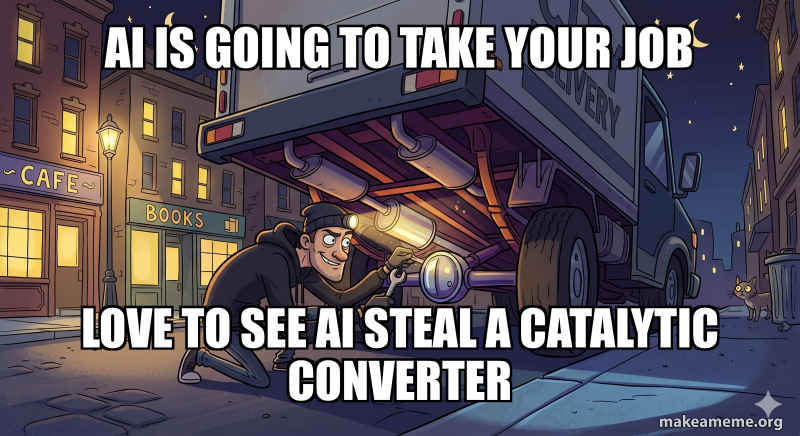
> In 2023, the Texas Legislature unanimously passed a law raising auto insurance costs for Texans by $1 to combat rampant catalytic converter theft.
> The Motor Vehicle Crime Prevention Authority, led by a board mostly appointed by Gov. Greg Abbott, has turned the $1 fee hike into at least 3,200 Flock cameras.
More coming. Meanwhile, secure your EV!!! Batteries will be next!!!
reply