Apple is simply printing money now. Remarkable financial success.
It is notable that between Q4 2010 and Q1 2011 (the latter includes the holiday season), the growth areas were the iPod [115%] and the iPad [75%]. Macs increased 6%, but actually decreased by 7% in the Americas.
It's hard to hold it as a "bad" result, but among such stellar results the relatively small 15% growth of the iPhone does stand out. Tomorrow the talking heads will probably play that up despite the incredible scale of these results.
It's really hard to look at quarter to quarter numbers and say that it's good or bad when you have the holiday buying season involved. It's better to look Year on Year (except for the iPad)
There's also different bits of the product lifecycle to consider. Ipods were refreshed in September, (probably in anticipation of the holidays), but they're down year on year. Iphones are nearing the mid point of the yearly cycle, and I'd expect them to be relatively flatish until summertime. (except for that whole verizon thing). Ipads should be mostly flatish, since world + dog expects a refresh in April. The fact that the ios devices aren't flat is saying that there's a huge demand for these things that hasn't been filled yet.
>Iphones are nearing the mid point of the yearly cycle, and I'd expect them to be relatively flatish until summertime.
I wouldn't expect that, at least not this year in the US. The iPhone goes non-exclusive here in a week or so as it hits Verizon stores. Most people are expecting a big jump in sales from Verizon customers who wanted iPhones but didn't want to switch to AT&T.
1) During the conference call, CFO Peter Oppenheimer stated [1] that Apple still can't handle demand for iPhone and they continually have to increase production.
2) Apple keeps adding partnerships with operators in various countries, the US is just a piece of the pie. They currently have agreements with 185 operators in 90 countries, but that's probably not even half of the major operators out there.
3) Sales are growing fastest in the Asia-Pacific region and Japan. IPhone sales doubled year over year in those regions and I doubt that's going to slow down, also because of Apple's marketing efforts there. For instance, Apple plans to open another dozen Apple Stores in China in 2011. It was also stated that the China retail stores are the ones with the highest revenue per store.
You missed the parenthesis. (except for the whole verizon thing)
I would expect certain parts of the IOS ecosystem to be flatish based on the product cycles. They're apparently undergoing a runaway chain reaction instead, without a corresponding change to the average sale prices to engage that part of the demand curve.
Therefore, there's a hell of a pentup demand, and we ain't seen nothing yet.
It's better to look Year on Year (except for the iPad)
Sure, but in this case the input in question is the renewed competition courtesy of Android. The natural question everyone will have is how that impacts the iPhone.
For reference, for the same quarter over quarter of 2009, iPhone sales increased 68%.
Iphones are nearing the mid point of the yearly cycle, and I'd expect them to be relatively flatish until summertime
I wouldn't expect this at all. While we might get a sense that everyone is like us, most consumers aren't planning their purchase around Apple's update cycle. They decide they want a smartphone so they go and buy one. We all know that the smartphone market is exploding, and there is a huge untapped reserve of potential customers, so the numbers now are generally big.
Regardless, the iPad and iPod more than make it up. While everone was talking about the 300,000 Android devices activated per day, over this quarter the combined iOS devices hit a simple division rate of almost 360,000 per day. That is amazing.
In the last quarter, 375,000 iOS devices were sold a day. Are you saying 75,000 Android media players and tablets are sold a day? Otherwise, Android is still not growing as fast as iOS.
If you are talking iOS devices then adding all of the Android ones here http://en.wikipedia.org/wiki/Comparison_of_Android_devices will give you an idea that it is easily possible to come out more than 75000 a day, although hard numbers for many of those devices are not available as Google doesn't activate them or doesn't count them in their "Phone" numbers as they are not phones.
// No, I don't think there are 22.5m Android media players and tablets sold a month.
Samsung recently announced that Galaxy Tab, the most popular Android tablet, hit the 1 million mark. [1] Sales of Android devices by Archos, Meizu and B&N -- even when combined -- are flat-out negligible compared to Apple's sales volume.
I'd be surprised if there are more than 5 million non-phone Android devices sold a month. Also keep in mind that the "300,000 Android phone activations a day" is not at all verified, let alone that it applies to the present. Even if the figure was correct, it may well have pertained to a peak during the holiday season.
Sure, but the Android tablet + media player market has been generally a giant bust thus far. A tonne of vapor, but very little action. I think that was a strategic failing on Google's part, as they intentionally kept criteria that crippled those markets while iOS was spreading far and wide (and that's all that really matters to a game developer).
Curious - If you add the Million+ Galaxy Tabs sold and every other manufacturer that sells Android like the Archos, B&N Nook Color, Chinese Androids(ZTE, Meizu) (see here for more http://en.wikipedia.org/wiki/Comparison_of_Android_devices ) then where does the Android vs iOS equation stand? There is no point in playing the Android vs iOS game if you include all iOS devices. The only meaningful/hard numbers available for Android are for SmartPhones - so Android SmartPhones vs. iOS SmartPhone is the only comparison you could validly make.
> The only meaningful/hard numbers available for Android are
> for SmartPhones - so Android SmartPhones vs. iOS SmartPhone
> is the only comparison you could validly make.
Why so? If I am a developer and my app runs the same on iPhone and iPod touch (and probably on iPad if I took time to make it universal) then I care not only about the iPhones.
Same applies for Android apps - your app will work on all Phones, Tablets, Media Players and what not with all the same caveats. So you either need to compare Android Phone to iOS Phones OR Android Phones+Media Players+Tablets with iPhones+iPod+iPad - that was the point.
Non iPhone devices account for more than the half of iOS devices sold if you count iPad, and ~40% if you don't.
What percentage of non-phone Android devices is compared to phones?
It is not possible to know - Google maintains a number of phones per day figure that only applies to Phones that are "with Google" phones which users activate using their Google accounts. Per the Android model, if a vendor makes a phone or tablet or Media Player without involving Google (and plenty do) then Google doesn't know about how many of those are sold. So if you are comparing the 300000 number Google put out - that is only valid for SmartPhones. You can club other categories but since there are no numbers (yet) for those categories of Android devices the comparison is not apples to apples. (See below posts for more data on how it is easy to see if you include most conservative numbers for the other categories, Android easily beats iOS at this number game)
I think they Galaxy Tabs are already counted as a consequence of them going for the "big phone" approach before Google relaxed their requirments for the market. (They've since announced Tabs with only Wifi and an iPod Touch-alike called the Galaxy Player).
As Zero mentioned, Galaxy Tab's count in Google's numbers. Google publishes numbers for devices that access the market, which is essentially every non-intentionally crippled device. They don't give the number just for smartphones, it just happens that it was overwhelmingly smartphones. The Nook might run Android, but unless the user roots it (which a vanishingly small percentage do) it doesn't operate as a normal Android device.
Google clearly says 300000 "Phones" and the Galaxy Tab cannot make calls. And they have no way to give you numbers that they can't count - so they aren't selectively giving you phone numbers - the other big part of Android is not tied to Google activation system and so there is no way for them to know. (Nook _is_ Android - 2.1 version to be specific - whether or not Apps are allowed to run on default version is not relevant.)
I guess where you are getting at is Android == Google and nothing else and it is somehow OK to compare Phone numbers to 3 separate categories put together because of your assumption that Android=Phones=Google. That's clearly not true but I guess from the down voting that I am disturbing a good number of fans with numbers so don't be worried - pick the number that makes you happy ;)
How do the holidays come into play if you look at numbers like that? iPods have always spiked tremendously in the holiday quarter and iPads might be similar while the iPhone might be less of a Christmas present. Is there some way to normalize the data?
Good question. If you look at Apple's revenue by product line [1], it does appear that iPad is following the same seasonality as iPhone sales. That means that sales spike in FQ1 and the other quarters are roughly similar. It looks like iPad sales in FQ2 will be about 5 million, slightly higher than FQ4-2010 [2].
Even though the iPad is on a refresh pattern two months earlier than iPhone, I don't think it's going to hamper performance for FQ2, especially since enterprise makes up an increasingly large part of sales.
Q/Q iPhone growth isn't that meaningful because they've been supply constrained. What you're actually seeing in that growth figure is how fast they've been able to grow iPhone production.


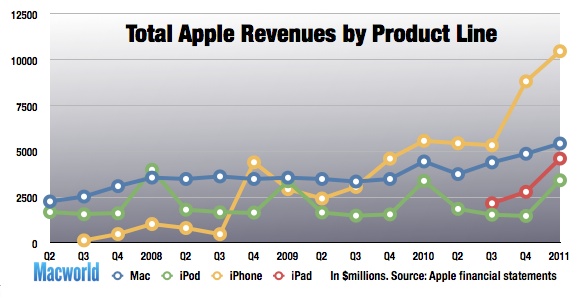
It is notable that between Q4 2010 and Q1 2011 (the latter includes the holiday season), the growth areas were the iPod [115%] and the iPad [75%]. Macs increased 6%, but actually decreased by 7% in the Americas.
It's hard to hold it as a "bad" result, but among such stellar results the relatively small 15% growth of the iPhone does stand out. Tomorrow the talking heads will probably play that up despite the incredible scale of these results.