> Base-load power is the power that continues to be generated even when there is low demand for it.
That is wrong. Base load is the minimum demand of electricity at any given moment over a time span. The base load that a wind turbine without buffer storage can supply is zero. The same goes for solar, obviously. The vast majority of renewable energy in Germany happens to be wind, its storage and transport remains the biggest (and unsolved) challenge.
> its storage and transport remains the biggest (and unsolved) challenge.
It's not 'unsolved' - it's just that it was economically not useful nor necessary nor wanted to store wind electricity in larger scales and this might be the case for another decade. Then we will see more storage coming online.
I live in Northern Germany with some possibility for higher wind electricity production. To store that one way is to build HVDC lines to Norway to store the excess electricity there as hydro power. One line is currently under construction and another one has been planned. The Netherlands is operating such a line to Norway since 2008.
Additionally inside Germany there is more delivery of wind-generated electricity to the south of Germany planned.
It's not 'unsolved' in the sense that we don't know what to do. It's just that storage needs are just starting to increase. Similar to PV solar technology - without a market no investment. Without investment, no market. Germany jump-started the PV solar market with its investments due to Renewable Energy Law. We will see similar effects in the coming decades for storage.
> It's not 'unsolved' - it's just that it was economically not useful nor necessary nor wanted to store wind electricity in larger scales and this might be the case for another decade. Then we will see more storage coming online.
The whole thing wasn't economically useful or necessary from the very beginning, otherwise it wouldn't have needed massive subsidies that made Germany have the most expensive electricity in Europe.
> It's not 'unsolved' in the sense that we don't know what to do. It's just that storage needs are just starting to increase.
You don't know what to do. The storage requirements are massive:
Think about it, if you did know what to do, why aren't all the politicians pointing to some clear-cut roadmap on how to achieve the goal, using all the great engineering prowess that Germany is famous for?
> The whole thing wasn't economically useful or necessary from the very beginning
That's your claim. Enough people here have been thinking the opposite.
> otherwise it wouldn't have needed massive subsidies that made Germany have the most expensive electricity in Europe.
Actually Germany a) does not have generally the most expensive electricity in Europe - check out industry prices for electricity in Europe.
If you followed recent protests in France, then you have seen that is also about higher energy prices for the public - which has been kept artificially low so far.
b) its also useful to make energy expensive - it helps to keep energy consumption low and the money gets invested back into modern infrastructure, research&development, build-up of new industries, ...
> The storage requirements are massive
That's a very shallow study about a non-goal (100%). A more detailed study from 2013:
Again, your „data“ consists solely of political aligned think-tanks.
Agora Energiewende is by no means a neutral organisation, with even proponents of green energy repeatedly criticizing agora for deliberately “making false assumptions out of unambiguous datasets”. [1]
> Again, your „data“ consists solely of political aligned think-tanks
Instead of trying to understand what the study describes (which is not 'data') you attack their so-called 'political alignment'. Then you deflect it to a totally different topic.
> Agora Energiewende is by no means a neutral organisation.
There are no neutral organizations. The goal of the foundation is well documented.
B.KWK Bundesverband Kraft-Wärme-Kopplung e.V. are proponents of cogeneration - which is a technology independent of 'green energy' and widely used with fossil-fuel or nuclear power plants.
The Bundesverband KWK is lobbying about lots of money - often for gas-powered power plants - while there was pressure from the EU to reduce/remove the special treatment by the German government.
That's only fair to say, therefore you must not mind me quoting some facts highlighted by "the other side":
"From the viewpoint of security of supply, so far wind power in Germany has replaced conventional power plant output of no more than 150MW. For comparison: In terms of the stability of the electricity grid in Germany, a power plant capacity of about 77,000 to 82,000 MW is required at the time of the annual peak load, which can occur usually on a late afternoon on a day in the period from November to February and is not known in advance"
Your source just doesn't really deal with base load at all, even though that's the giant pink cigar-smoking elephant in the room. It can't be taken serious. It's starting with a premise ("Energiewende" is necessary) and works its way backwards, carefully avoiding to deal with the real issues. It's implying significant technological breakthroughs coming out of left field. It's all supposed to happen with taxpayer/consumer money, thrown around like candy. There's profiteering everywhere, lots of PR and lobbying, lots of moral grandstanding. In that environment, I can almost guarantee you, the money will be in the wrong hands. It won't be there when the real opportunities appear.
That's common sense. If something is both economically useful and necessary, it finances itself. You don't need subsidies at all, at most you need loans.
> Enough people here have been thinking the opposite.
So what? If "enough people" believe in Santa Claus, does that mean he'll all bring us presents on Christmas?
> Actually Germany a) does not have generally the most expensive electricity in Europe - check out industry prices for electricity in Europe.
Yes, industry is exempt because of lobbying. If industry had to pay those horrendous prices, it would damage Germany's competitiveness. Therefore, more to pay for the average citizen.
> If you followed recent protests in France, then you have seen that is also about higher energy prices for the public - which has been kept artificially low so far.
First of all, France has the cheapest electricity in all of Europe. Those protests were sparked by a "green tax" on fuel. I don't know what your point is, but it sounds like "green policy causes civil unrest in France". It's not helping your argument.
> That's a very shallow study about a non-goal (100%).
Fine, you may rely on 20% fossil fuels and maybe you'll be able to reduce the required storage cost from "absolutely infeasible" to "monumentally expensive". All to the end of removing a smidgen (less than 1%) from global CO2 emissions. The rest of the (developing) world isn't going to follow suit with that kind of pretentious nonsense.
> A more detailed study from 2013
That's all projections on what should happen, based on lots of ifs and maybes. It's utterly useless.
> That's common sense. If something is both economically useful and necessary, it finances itself. You don't need subsidies at all, at most you need loans.
That's an illusion, especially in the energy sector. It has been for decades.
> France has the cheapest electricity in all of Europe.
Because the costs are hidden and paid by the tax payer. The energy industry is mostly state owned and the price is political. That makes it not possible to charge the consumer with the real costs (like finding billions for the aging and expensive nuclear reactor fleet or for replacing them with newer reactors) - any president trying to do so would and does face mass protests. Additionally, the industry would be dead in a second if the government wouldn't finance the costs and hide it from the consumer.
One can see how this works in the UK with EDF's reactor:
"If Hinkley really comes on stream by 2025 as planned, it will sell electricity at a guaranteed price that is double the current market level, with the excess cost passed to every UK consumer"
> That's an illusion, especially in the energy sector. It has been for decades.
It's not an illusion, it's the basis of the economy. If something is known to be both useful and necessary, there is a profit to be made and capital will be allocated to it. That's the financial side. Of course for the energy sector there are lots of ideological, environmental and political concerns that need to be dealt with for things to actually happen.
> Because the costs are hidden and paid by the tax payer. The energy industry is mostly state owned and the price is political. That makes it not possible to charge the consumer with the real costs (like finding billions for the aging and expensive nuclear reactor fleet or for replacing them with newer reactors) - any president trying to do so would and does face mass protests.
Hard to ascertain. If it was really that unprofitable to produce nuclear energy compared to the (clean) alternatives, France could just build the alternatives. After all, the state foots the bill either way, unlike a private company that can just go bankrupt and not clean up their mess.
> One can see how this works in the UK with EDF's reactor:
> "If Hinkley really comes on stream by 2025 as planned, it will sell electricity at a guaranteed price that is double the current market level, with the excess cost passed to every UK consumer"
Yes, but the "current market level" is lower because of fossils, not because of renewables, which also need heavy subsidy. You can't have your cake and eat it too. If we're just arguing about market price, then clearly coal is the winner.
> Actually quite a lot of countries are.
None of the countries that really matter (have a significant share in CO2 emmissions) are.
> It's not an illusion, it's the basis of the economy.
Maybe in a simple model of capitalism.
> Of course for the energy sector there are lots of ideological, environmental and political concerns that need to be dealt with for things to actually happen.
Example: no one invests in a nuclear power plant - unless the state insures the thing, finances (incl. all the costs that come from technological and construction problems) the thing all through from inception to research to design to construction to bringing it online AND (!!!!!) creates the economic conditions for profits to be made (like dictating prices, reducing competition, financing all costly technological and construction risks, providing cheap infrastructure, ...). -> Example: currently the UK.
The energy sector it's very different from selling beans to consumers.
> France could just build the alternatives
But it hasn't. France has built nuclear for many reasons - for example France is a country with nuclear weapons and thus has an interest in nuclear technology. There is also an ideological trend to large state-driven/owned technologies.
Now France is looking to expand its share of renewables - while at the same time trying to find hundreds of billions for their reactor fleet.
> After all, the state foots the bill either way, unlike a private company that can just go bankrupt and not clean up their mess.
That's not how it works in the energy landscape. Check out TEPCO. The Japanese state does not let it die.
> None of the countries that really matter (have a significant share in CO2 emmissions) are.
You are shifting the goal post all the time. If enough countries do it (for example in the EU), then it matters.
You may call it capitalism, but even the birds and the bees "understand" the concept of investing now for future gains.
> Example: no one invests in a nuclear power plant - unless the state insures the thing, finances (incl. all the costs that come from technological and construction problems) the thing all through...
That's just not true, lots of private capital has financed reactors before. Note that I never claimed that nuclear reactors are economically sensible (especially counting in disasters), but that if they were they would finance themselves. Indeed, there's a lot of hard-to-calculate risk in a nuclear reactor, which is bad from an investment standpoint.
> But it hasn't. France has built nuclear for many reasons - for example France is a country with nuclear weapons and thus has an interest in nuclear technology.
So what? The U.S. has the one of the largest nuclear arsenals in the world, yet they barely do nuclear at all.
> There is also an ideological trend to large state-driven/owned technologies.
So why don't they build giant state owned wind turbines?
> That's not how it works in the energy landscape. Check out TEPCO. The Japanese state does not let it die.
Whatever they do, the company isn't going to (be able to) pay the bill, unless they're not in fact bankrupt.
> You are shifting the goal post all the time. If enough countries do it (for example in the EU), then it matters.
Not really. Which countries are you talking about? The EU makes up maybe 10% of CO2 emissions and a big part of that isn't related to electricity. Think of all the research you could fund with the money spent on that forced premature rollout of renewable energy in Germany. Think of all the money that still needs to be spent to make it work. Think of what you actually achieved in terms of CO2 goals, so far. It's an absolute embarrassment.
> That's just not true, lots of private capital has financed reactors before.
Mostly not. For example France's reactors were 100% state financed and state owned. Incl. the electricity distribution and the building company (Areva).
In Germany the whole nuclear industry was state directed and the power plants were belonging to a few companies - with electricity companies being 'forced' by the government to invest in nuclear electricity production. The whole research around nuclear technology (fuel production, reactor technology, storage, ...) was state financed. The electricity companies were given huge distribution areas where they had a monopoly without any competition. Politicians were given well-paid jobs in the industry.
> economically sensible (especially counting in disasters), but that if they were they would finance themselves
The reality shows the opposite. See the UK: nuclear power does not finance themselves by market mechanisms. The financing is set up by the government and there is no market. To build them is a political decision and the UK government sets the market accordingly. Well, it tries to.
> So what? The U.S. has the one of the largest nuclear arsenals in the world, yet they barely do nuclear at all.
What does it have do with France what the US does?
> unless they're not in fact bankrupt
They are not bankrupt while they get more government money.
> Think of all the research you could fund with the money spent on that forced premature rollout of renewable energy in Germany.
There is lots of money spend on research in Germany ... nut now much more on renewable energy. The research was already instrumental to bring PV prices down and make the technology applicable on a large scale. The impact of that was far beyond Germany.
> Think of all the money that still needs to be spent to make it work.
Well invested.
>Think of what you actually achieved in terms of CO2 goals, so far. It's an absolute embarrassment.
It's not. The Energiewende is not about short-term CO2 reductions.
It's a broad long-term project to switch the energy landscape to renewable energy - starting with electricity, starting with getting rid of nuclear power. Coal is next. It has a five decade horizon.
Doesn't matter. Your claim, as written, was wrong.
> The reality shows the opposite. See the UK: nuclear power does not finance themselves by market mechanisms.
Again, I didn't say that it would. I said that anything that is economically sensible finances itself, pretty much by definition. I didn't say nuclear power is sensible and I didn't say that it finances itself.
> What does it have do with France what the US does?
If your explanation doesn't generalize to the US, then it is wrong. You might as well say France builds nuclear reactors because it is France. You only need a single reactor to build a nuclear arsenal, so having an interest in nuclear weapons is no explanation for why France (or any other country) would invest in building out lots of civil nuclear infrastructure.
> They are not bankrupt while they get more government money.
You are supporting my thesis. Go back and read it. It's about a private company, contrary to a state, being able to relieve itself of the bill. That's exactly what's happening here, whether Tepco is formally bankrupt or not.
> There is lots of money spend on research in Germany ...
Way to miss the point...
> The Energiewende is not about short-term CO2 reductions. It's a broad long-term project to switch the energy landscape to renewable energy.
What's the point of switching electricity to renewables if not CO2 reduction? There's enough coal for hundreds of years.
Germany does not have a single wind turbine in a single location. It has vast numbers of them across many locations, many of which are situated in areas with near near constant wind. Across the whole portfolio of this production resource there is a certain minimum level of production which is consistently maintained. And, unlike a coal plant, there is almost zero risk of the whole system failing. In my country (Australia) we frequently see coal power plants 'trip' (breakdown), particularly in hot weather. [1]
And on the question of the definition of base-load, it was originally defined in terms of supply (production). Yes, the meaning has spread to demand but the idea that base-load demand must be supplied by 'base-load' power plants such as coal or nuclear is a piece of sophistry that quickly dissolves when it is examined closely. Just one reason being that their supply is not guaranteed (as I have described above).
Not only trips in the heat as happened with Loy Yang B last summer; Loy Yong A was offline last week for maintenance right in time for the hottest day of the summer so far.
There are plenty of good places for turbines in Victoria such as near "Windy Warrnambool". At around 38° south it gets nearly constant westerlies.
> Germany does not have a single wind turbine in a single location. It has vast numbers of them across many locations, many of which are situated in areas with near near constant wind. Across the whole portfolio of this production resource there is a certain minimum level of production which is consistently maintained.
Yes, but it's a fraction of total output and it's nowhere near enough to supply the actual base load.
> Yes, the meaning has spread to demand but the idea that base-load demand must be supplied by 'base-load' power plants such as coal or nuclear is a piece of sophistry that quickly dissolves when it is examined closely. Just one reason being that their supply is not guaranteed (as I have described above).
What quickly dissolves into sophistry is the idea that wind energy is remotely comparable to coal or nuclear in terms of supplying base load. Yes, an individual coal plant doesn't have 100% reliability, but it's still massively less volatile than wind.
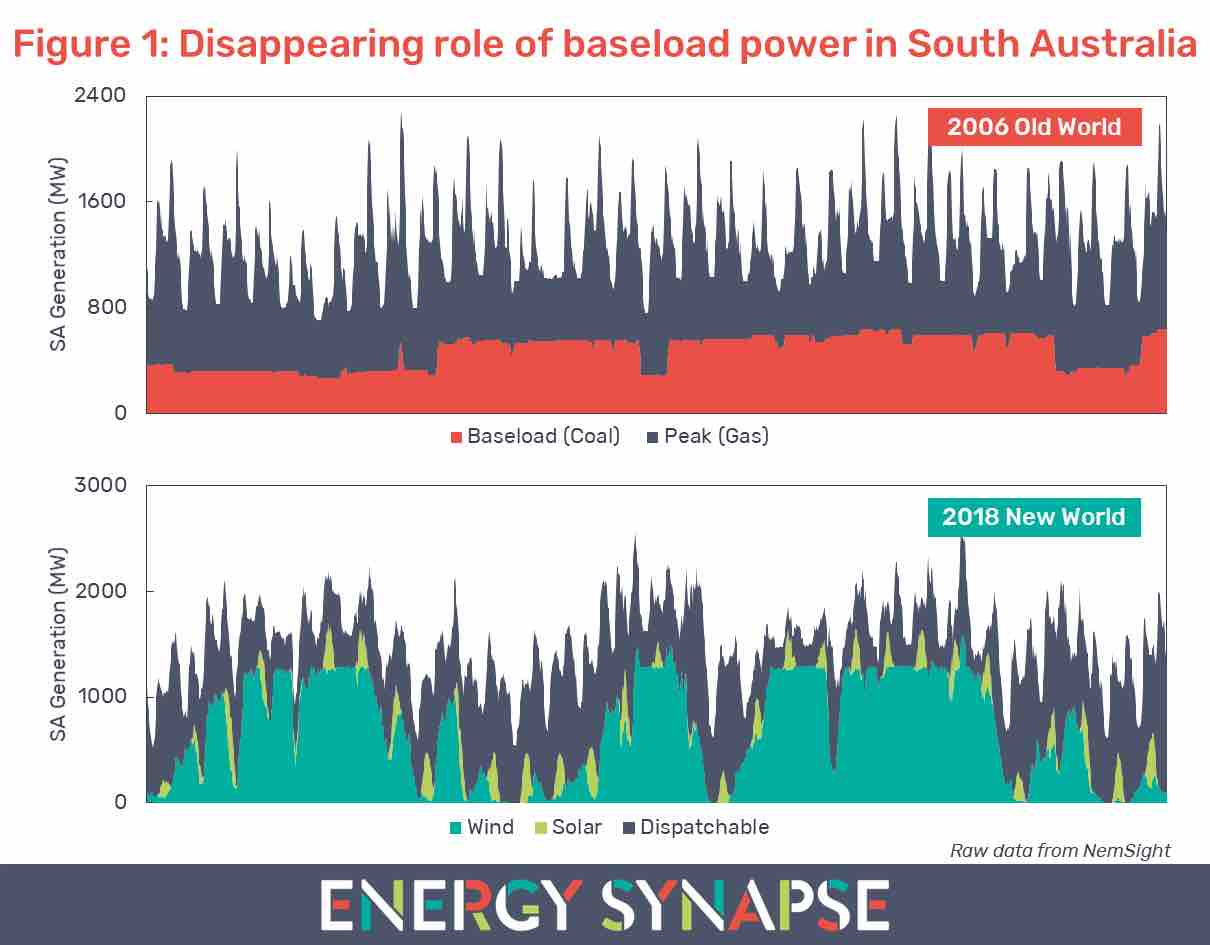
What's that big grey part that is "dispatchable"? It's mostly natural gas, which Australia has plenty of (7% of exports), but Germany would need to import. Australians can pat themselves on the back for not using any more coal in the grid, but they still ship it off (16% of exports) for someone else to burn it.
Batteries and pumped hydro can also deliver dispatchable and Australia is embracing and building both. The focus of today's markets is on flexibility and response time of supply, not on lumbering, inflexible baseload. Batteries are the most rapid and flexible, as the big battery constructed in South Australia has amply proved.
Flexibility is not the crucial issue. It's just what that large Tesla battery is good at, which is why everyone highlights it. In terms of capacity, it's next to nothing. No proponent wants to talk about that.
If you just look at the graph you'll see that dispatchable makes up almost 100% of base load during significant periods of time. Do the math on how many batteries and how much pumped storage you would need. It's simply not happening without fossils.
Australia uses natural gas so it can pull down CO2, but the coal is still exported and burned by someone else. It's a wash. Germany only has coal. If storage was feasible they wouldn't be standing there with their pants down on their CO2 goals. They would've built the best batteries and storage pumps the world knows.


That is wrong. Base load is the minimum demand of electricity at any given moment over a time span. The base load that a wind turbine without buffer storage can supply is zero. The same goes for solar, obviously. The vast majority of renewable energy in Germany happens to be wind, its storage and transport remains the biggest (and unsolved) challenge.