> You just can't very reliably go across the country because some of our states are larger than many, if not most, European countries.
This is such a weird argument. I can take a train from London to Paris to Zurich to Berlin, despite them being entirely different countries. You're telling me travelling between US states is somehow massively harder?
> Compare a topography map of Sweden with California.
Switzerland has a) some of the most challenging topography in the world and b) one of the most extensive, heavily used train systems in the world.
> This is such a weird argument. I can take a train from London to Paris to Zurich to Berlin, despite them being entirely different countries. You're telling me travelling between US states is somehow massively harder?
I think this has to do with the frequency of rest-stops/ tourist destinations.
There are many places to stop and see if you were to have a track going through all of the EU, but if you do that with the U.S, you're just going through "nothing" for hours on end. There's no site-seeing, sparse and isolated rest-stops, etc.
This is if we assume coast-to-coast travel, not just state-to-state. If we do, it's just not worth it to spend that much money.
How long does it take for a train to get from London to Paris? A few hours? We have something like that: the Amtrak northeast corridor line between DC and Boston (with stops in Baltimore, Philly, NYC, and others along the way). Going from DC to NYC is probably somewhat comparable, and I think that takes 3.5 hours. However, going from the east coast to the west coast on a train means several days of travel. We do have that too, with Amtrak. It's horribly slow and no one uses it except people who really want the "see the nation on a train" experience. It's also really expensive, because you'll surely want a sleeper cabin for such a long trip.
The rail network in Switzerland runs primarily through the easiest to deal with terrain. There are a few lines that go through mountainous terrain. IIRC, none of them are any worse than some of the easiest traversals of the Rockies.
Your examples are all within a pretty close range of each other. Not to mention all being popular tourist destinations. Throw a trip to Italy in there and it doesn't change much. You've traveled to four different countries: roughly the size of a few states and only a fraction of the size of the US.
A train from New York to Miami, Florida is around 2057 km leaving from Penn Station. From Paris to Zurich and Zurich to Berlin is 1622~ km. Although a tad larger going back to Paris from Berlin, a total of 2676 km.
So for comparable distances and from [Tourist Attraction] --> [Tourist Attraction] things are comparable.
Take a train around all of Germany, Switzerland, and France. The entire countries - and not just the capitals! You've still only covered a small portion of the US [0].
Things don't work when there is large amounts of nothing between areas that need to be connected. This is also why the US has laughably bad internet connections in most of the nation. It isn't worth laying down fiber in towns with populations <5,000 nor is it worth laying down rail.
Size isn't the only issue but it is, in my opinion, the largest issue. Pun not intended.
>Switzerland has a) some of the most challenging topography in the world and b) one of the most extensive, heavily used train systems in the world.
My understanding of it is as coredog64 said in their reply, but also Switzerland is yet-another-tiny-country. It'd be more fair to compare it with a 3rd of New York. Does a third of New York have an extensive, heavily used train system? Yes. It so happens to have one of the most extensive rail systems out of any state in the US even! Why? My guess is the size: it's a smaller state with more concentrated populations.
New York (State): 141,300 km²
Switzerland: 41,285 km²
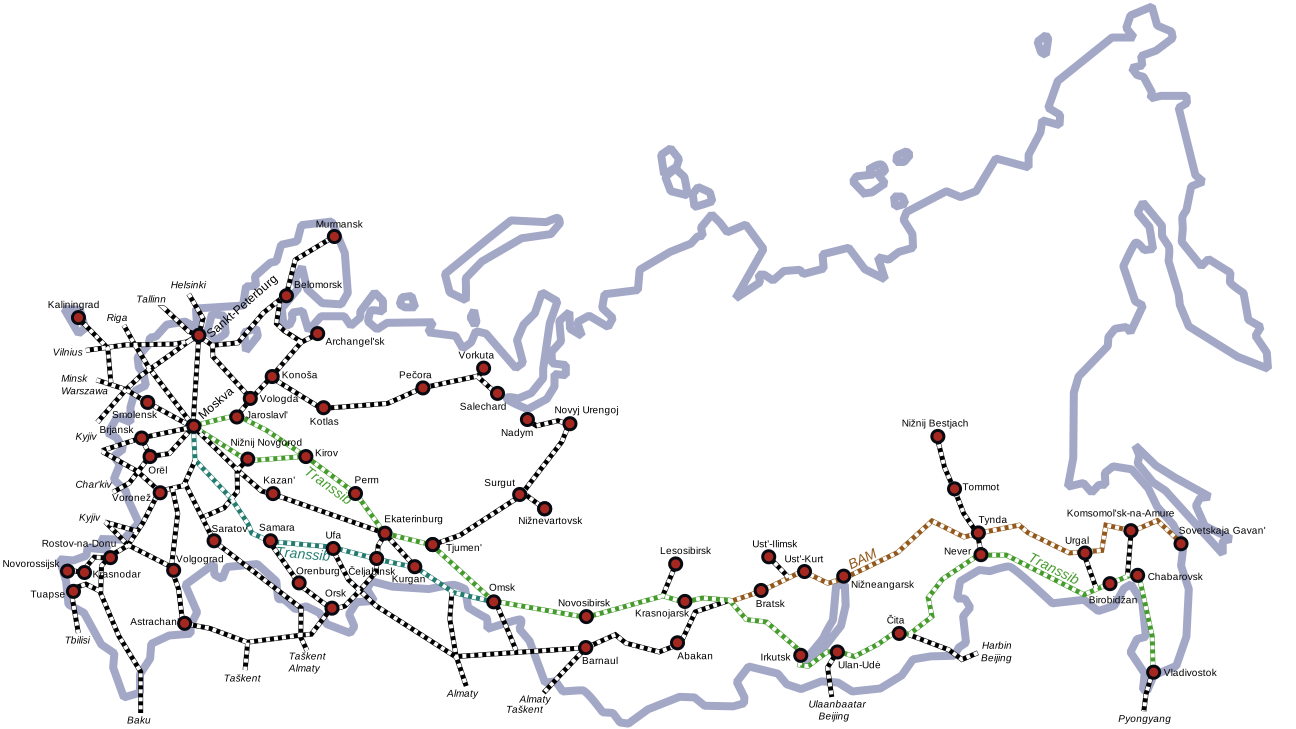
Does anyone have information on how extensive and heavily used public transport is in, say... Russia? Then we'd at least be closer to any size comparisons. I'm only familiar with Moskva and Sankt-Peterburg (Moscow and Saint Petersburg) which is the capital and the second largest city, so I'd expect them to be well connected - so that isn't exactly saying much. Looking at the rail map on Wiki [1] doesn't tell you which are public transport lines and which are freight lines. So it's hard to get a good idea.


This is such a weird argument. I can take a train from London to Paris to Zurich to Berlin, despite them being entirely different countries. You're telling me travelling between US states is somehow massively harder?
> Compare a topography map of Sweden with California.
Switzerland has a) some of the most challenging topography in the world and b) one of the most extensive, heavily used train systems in the world.